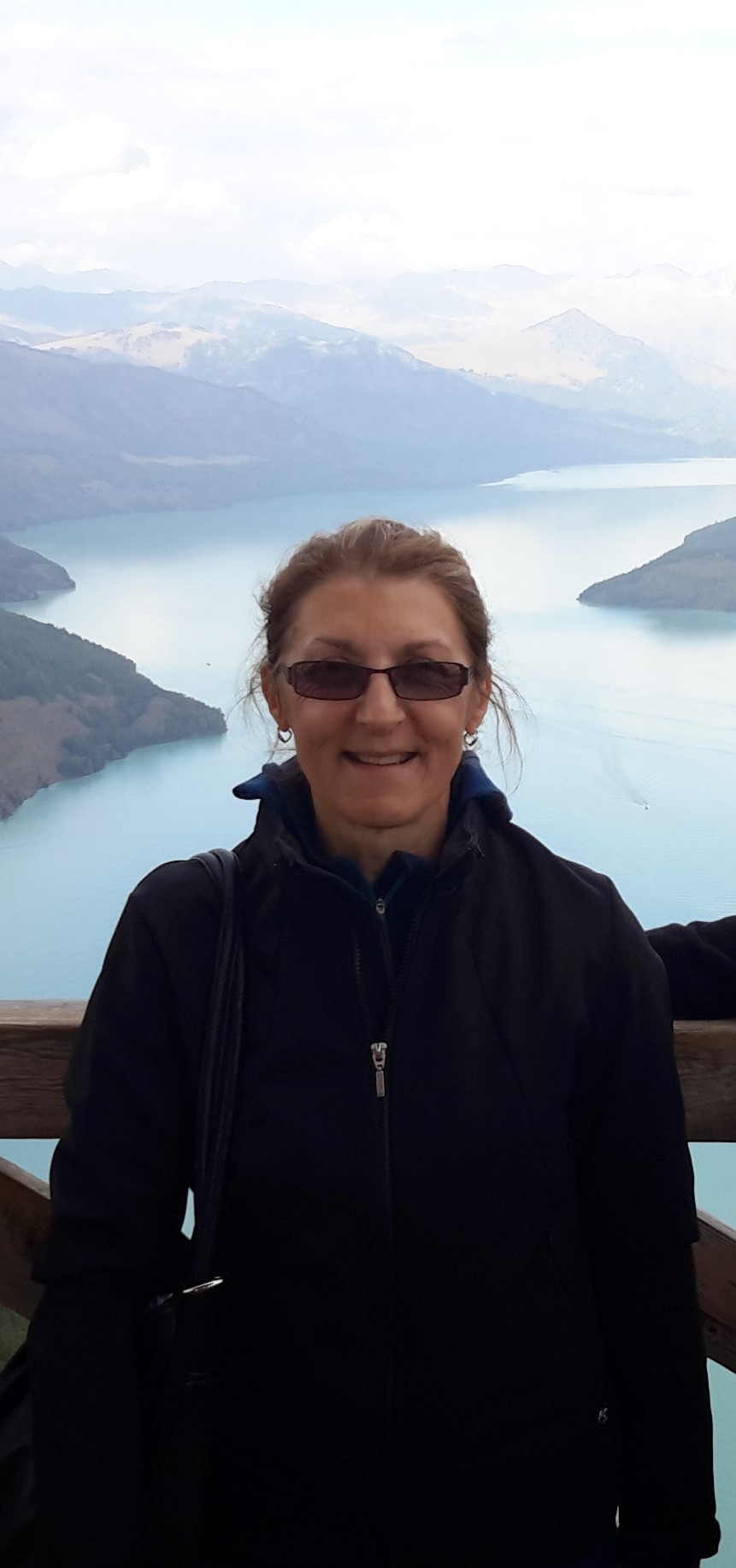
I was born in Melbourne, Australia and after completing my high school education embarked on a Bachelor of Education in Environmental Studies. During the course of the four year degree, I developed a passion for botany and physical geography. My first encounter with bryophytes was during the third year of my degree where I was required to complete a research project. I decided to focus on desiccation tolerance in plants. For the project I needed plants that were small enough to fit into a chamber attached to an oxygen electrode. Bingo – bryophytes!
After graduating, bryophytes were put on hold as I pursued a teaching career in a secondary school, then as a tutor in a university and bringing up two daughters. It was whilst tutoring that I decided to complete a postgraduate degree. I returned to bryophytes and focused on the reproductive biology of the moss genus Dicranoloma in cool temperate rainforests. Over a three year period I collected and examined plants to track the development of males and females. A steady hand was essential when dissecting dwarf males that are a distinctive character of the genus. I also became fascinated by the invertebrates that inhabited these plants, mites in particular. By the end of the project, I was hooked on bryophytes, mosses in particular. I was awarded a PhD for my thesis: ‘Studies of the biology of four species of Dicranoloma.’
I was fortunate to gain employment at the Royal Botanic Gardens Victoria (RBGV) and worked in the National Herbarium of Victoria (MEL) for 24 years, retiring in November 2021. Whilst at the Gardens I completed flora treatments of a number of moss families, including the family Neckeraceae for the Australian Biological Resources Study program (https://www.anbg.gov.au/abrs/Mosses_online/). This project was completed with Dr Niels Klazenga who was a great support and mentor. Although I am particularly interested in rainforest mosses, the composition and dynamics of bryophytes in soil crusts has also been of interest.
Public engagement and community awareness of bryophytes has always been one of my areas of focus, particularly because of my education background. Whilst at the RBGV it became apparent that there were limited resources for teachers so with colleagues the Forgotten Flora (bryophytes, lichen & fungi) Education kits which comprised information and activity booklets and 10 posters were produced. This project was a stepping stone into another project with colleagues at the RBGV which involved the development, curation and touring of the exhibition, Hidden in Plain View the forgotten Flora. The exhibition focused on bryophytes, fungi and lichens.
In 2006 I was appointed to the position of Collections Manager at MEL and as time allowed, I continued my interest in bryophytes by collecting, identifying and vouchering. I also had the opportunity to collaborate with Dr Christine Cargill (CANB) and Dr Laura Forrest on research focusing on the complex thallose liverwort Monocarpus and more recently, on Riella with Chris Cargill.
Everywhere I travel I am inevitably drawn into looking down on the ground, in cervices or tree trunks for bryophytes. If I have my family, including my young grandsons or friends with me, they too are required to join in my enthusiasm for bryophytes. A hand lens or magnifying glass which reveals the beauty of the plants soon has them interested.
Selected publications:
D. C. Cargill, J. Milne, L. L. Forrest and C. Gueidan (2017) Disjunct populations of Monocarpus sphaerocarpus (Monocarpaceae, Marchantiopsida) within Australia show no sequence variation. Muelleria 35: 35-42.
Forrest, L.L., Long, D.G., Cargill, D.C., Hart, M.L., Milne, J., Schill, D.B., Seppelt, R.D. and. Villarreal, J.C. (2016). On Monocarpus (Monocarpaceae, Marchantiopsida), an isolated salt-pan complex thalloid liverwort. Australian Systematic Botany 28, 137–144.
Cargill, D.C. & Milne, J. (2013) A new terrestrial genus and species within the aquatic liverwort family Riellaceae, (Sphaerocarpales) from Australia. Polish Botanical Journal 58(1): 71–80.
Milne, J. and Jolley, H. (2010). The importance of herbarium records in documenting the occurrence and changing distribution of the adventive moss species Pseudoscleropodium purum in Victoria. Victorian Naturalist 127, 146–150.
Milne, J., Short, M. and Beckmann, K. (2006). A preliminary study of bryophytes and invertebrates of soil crusts in the Little Desert National Park and surrounds. Victorian Naturalist 123, 195–203.
Kellar, K., Short, M. and Milne, J. (2006). Epiphytes on Nothofagus cunninghamii and Eucalyptus regnans in a Victorian cool temperate rainforest. Victorian Naturalist 123, 222–229.
Milne, J. (2006). The genus Diphyscium in Australia. Journal of Bryology 28, 194–197.
Milne, J. (2002), Review of: Key to the genera of Australian mosses, by W.R. Buck, D.H. Vitt & W.M. Malcolm. Flora of Australia Supplementary Series Number 14. Australian Biological Resources Study, New Zealand J. Bot 40(4): 701-702.
Milne, J. (2001). Reproductive biology of three Australian species of Dicranoloma (Bryopsida, Dicranaceae): sexual reproduction and phenology. The Bryologist 104, 440–452.
Milne, J. (2000). Gemmae in Dicranoloma serratum (Broth.) Par. Journal of Bryology 22, 70–72.
Milne, J. and Louwhoff, S. (1999). Vertical distribution of bryophytes and lichens on a Myrtle Beech, Nothofagus cunninghamii (Hook.) Oerst. Hikobia 13, 23–30.