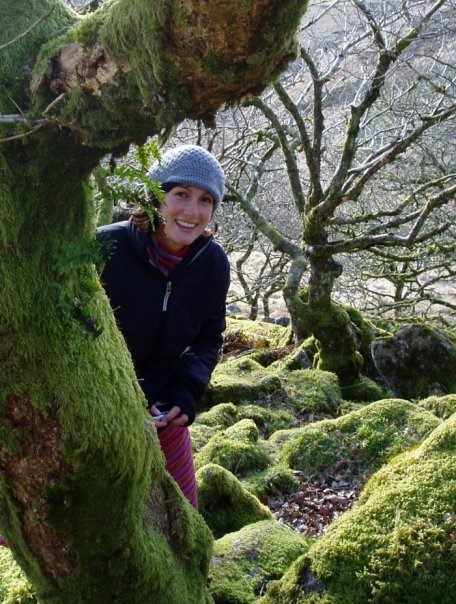
I first began working in ecology and conservation in Australia in the late 1990s. I’ve had an eclectic career, working on the conservation of both threatened flora and fauna for state governments and consultancies, but I’ve always had a passion for community ecology, and since completing a PhD at Monash University, Australia, on the drivers of bryophyte diversity in Victorian cool temperate rainforest, bryophytes have been closest to my heart.
My doctorate in the early 2000s investigated the effects of habitat patchiness at the micro, forest-stand and landscape scales on the diversity of bryophytes in cool temperate rainforest. In 2009, the Black Saturday fires in Victoria burnt about half the rainforest patches in which I’d previously conducted research. Thus, sadly, I was provided with an opportunity to investigate the effects of fire on rainforest. It was a slow process of grieving to observe the loss of rainforest patches, at first and most catastrophically, smaller patches at higher elevation sites, and then more slowly, the erosion of the edges of larger rainforest patches by the cumulative, longer-term effects of fire and logging disturbance.
Observing the impacts of such a catastrophic wildfire event galvanised me to focus my efforts on being a part of mitigating the impacts of climate change on Australian temperate rainforests. This, and taking time away to raise young children, prompted me to branch out from science for several years into the world of fiction and nature writing, in an attempt to connect through the heart and to more viscerally allow people to experience the effects of climate change.
Now, with kids slightly older, I’m refocussing on how climate change and fire are affecting cool temperate rainforest in Victoria, with a particular focus on its dependent biota.
Bryophytes mean so much to me; as symbols of resilience and persistence, of wise and intricate adaptation to their particular circumstances, and as beings whose beauty still takes my breath away.

Selected References:
Worley M (2012) Impacts of the 2009 Kilmore East-Murrindindi bushfires on cool temperate rainforest in the Victorian Central Highlands. Black Saturday Victoria 2009 Natural values fire recovery program Project No.2, Department of Sustainability and Environment, State of Victoria: Melbourne.
Worley M (2007) Effects of habitat patchiness on bryophyte diversity across multiple scales in Nothofagus cunninghamii-dominated cool temperate rainforest in the Victorian Central Highlands. PhD Thesis, Monash University, Clayton.
Dell M, Worley M, McMullan-Fisher SJM and Casanova MT (2020) An assessment of conservation priorities and actions for bryophytes, algae and fungi in response to Victoria’s 2019-2020 bushfires. Technical Report DOI: 10.13140/RG.2.2.21042.32967.
Worley M (2016) ‘Green and Belonging’ pp. 37–49 In Deep Green Living, Ed. Marian Van Eyk McCain, GreenSpirit (GreenSpirit Book Series: London). ISBN: 9780993598302.
Bennett J, Harley D, Worley M, Donaldson B, Andrew D, Geering D, Povey A & Cohen M (2000) ‘Watching Wildlife Australia’ Lonely Planet Publications: Melbourne. ISBN: 9781864500325.