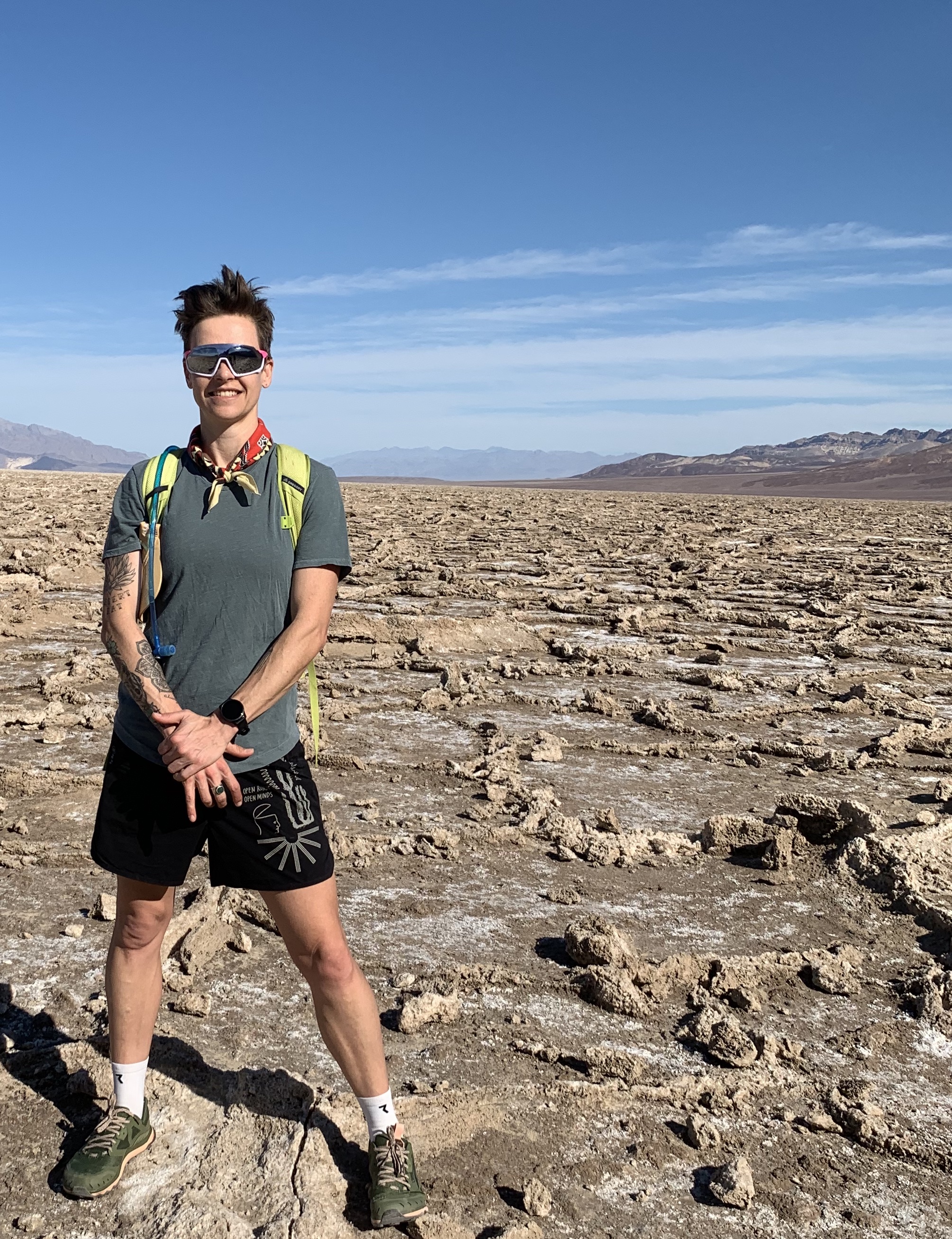
Born and raised in West Baltimore (Maryland, USA), I was originally exposed to botany in the context of an urban trail system near my house as well as an Ecology class taught at my Quaker elementary school. My interest in bryology, however, was piqued when I was fortunate to be a student of Robin Wall Kimmerer (SUNY ESF), from whom I took the course ‘The Ecology of Mosses’ and with whom I worked on my first research project as an undergraduate: examining microhabitat partitioning of Anomodon species on limestone outcrops. I was immediately drawn to the micro-world of bryophytes and struck by how much there was still to be learned about their ecology. Simultaneously, among the most memorable travels of my formative years were to the Southwestern U.S., where I was captivated by desert landscapes and dryland indigenous cultures. Towards the end of my time as an undergraduate and over a two-year period before I began graduate school, I worked and traveled in the drylands of South Africa, Namibia, and Botswana, and found myself constantly in awe of their biological diversity, ecology, and beauty. The smell of African desert soil after a rain is like nothing else in this world.
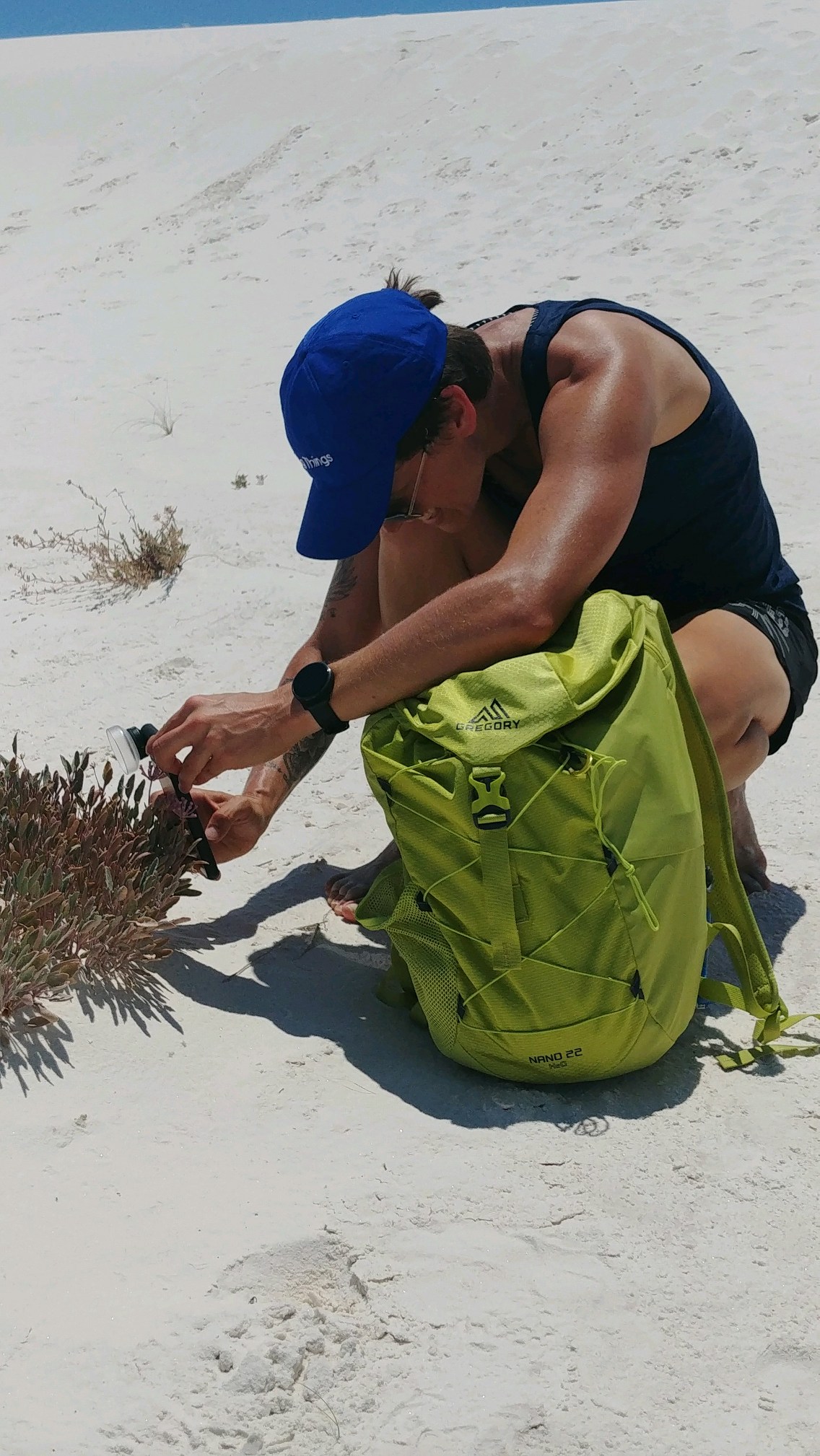
My passions for bryology and dryland ecology converged in my Ph.D. program at Cornell University (New York), where, working in Jed Sparks’ ecophysiology and biogeochemistry lab, I examined dryland biocrust moss physiological responses to global change. In collaboration with Jayne Belnap, Sasha Reed, and the US Geological Survey “crust lab” in Moab, Utah, I discovered that certain precipitation projections (specifically, smaller rainfall events occurring during the summer months) cause Syntrichia mosses to enter carbon deficit and ultimately suffer mortality, on rapid (<6 month) timescales. Scaling up these responses to represent climate scenarios for the Western U.S. revealed that most projections of increased drought and/or reduced precipitation for the coming century will negatively influence biocrust moss functioning and survival. As Syntrichia is a keystone biocrust organism, we also found that loss of moss from the crust community is likely to fundamentally alter dryland carbon and nitrogen cycling.
My postdoctoral appointments took me first to the Alaskan tundra, and then to temperate forests and peatlands of the Northeastern U.S. In each of these environments, I continued to pursue a broad interest in bryophyte ecophysiology and feedbacks to ecosystem function. I am currently an Assistant Professor at Middlebury College in Vermont, where my work in bryology follows two main themes: (1) Ecophysiology of desiccation tolerance in the dryland moss clade Syntrichia (3dmoss.berkeley.edu); and (2) Bryophyte-cyanobacteria symbioses in temperate systems as drivers of nitrogen cycling. Finally, I am engaging in ongoing work to build a framework of bryophyte functional traits with my dear friends and colleagues Mandy Slate, Daniel Stanton, and Ben Carter. Woven through all of my research efforts is an ever-evolving commitment to decolonial research methodology and respect for indigenous ways of knowing.
Being a bryologist is to be constantly learning, and to be consistently in awe. The most rewarding aspects of my work lie with the people with whom I get to learn, and the incredible landscapes we get to explore together.
Selected publications:
Antoninka, A., Chuckran, P.F., Mau, R.L., Slate, M.L., Mishler, B.D., Oliver, M.J., Coe, K.K., Stark, L.R., Fisher, K.M. and Bowker, M., (2022) Responses of biocrust and associated soil bacteria to novel climates are not tightly coupled. Frontiers in Microbiology 13:821860(link)
Stanton, D. and Coe, K.K. (2021) 500 million years of charted territory: Functional ecological traits in bryophytes. Bryophyte Diversity and Evolution 43(1): 234-252 (link)
Carvajal Janke, N. and Coe, K.K. (2021) Evidence for a fungal loop in shrublands. Journal of Ecology 109(4): 1842-1857 (link)
Silva, A.T., Gao, B., Fisher, K.M., Mishler, B.D., Ekwealor, J.T.B., Stark, L.R., Li, X., Zhang, D., Bowker, M.A., Brinda, J.C., Coe, K.K., Oliver, M. (2020) To dry perchance to live: insights from the genome of the desiccation-tolerant biocrust moss Syntrichia caninervis. The Plant Journal. (link)
Slate, M., Brinda, J., Coe, K.K., Greenwood, J. and Stark, L. R. (2020) Prehydration mitigates damage accrued from prolonged periods of desiccation in cultured shoot apices of Syntrichia ruralis. Journal of Bryology. 18: 1-12 (link)
Coe, K.K., Greenwood, J., Slate, M., Clark, T, Brinda, J., Fisher, K., Mishler, B., Bowker, M., Oliver, M., Ebrahimi, S., and Stark, L.R. (2020) Strategies of desiccation tolerance vary across life phases in the moss Syntrichia caninervis. American Journal of Botany. 108(2): 1-14 (link)
Coe, K.K., Howard, N., Slate, M., Butler, R., Greenwood, J., Bowker, M., Mishler, B., and Stark, L. (2019) Morphological and physiological traits in relation to carbon balance in a diverse clade of dryland mosses. Plant, Cell, and Environment. 42(11): 3140-3151 (link)
Deane-Coe, K.K. & Sparks, J. P. (2016) Cyanobacteria associations in temperate forest bryophytes revealed by ?15N analysis. Journal of the Torrey Botanical Society143(1): 50-57 (link)
Deane-Coe, K.K., Mauritz, M., Celis, G., Natali, S., Salmon, V., Crummer, K.G. & Schuur, E.A.G. (2015) Experimental warming alters productivity and isotopic signatures of tundra mosses. Ecosystems18(6): 1070-1082 (link)
Coe, K.K. & Sparks, J. (2014) Physiology-based prognostic modeling of the influence of changes in precipitation on a keystone dryland plant species. Oecologia176(4) 933-942 (link)
*Reed, S., *Coe, K.K., Sparks, J., Zelikova, T.J., and Belnap, J. (2012) Changes to dryland rainfall result in rapid moss mortality and altered soil fertility. Nature Climate Change 2:752-755 *dual 1st authorship(link)
Coe, K.K., Belnap, J. & Sparks, J. (2012). Precipitation-driven carbon balance controls survivorship of desert biocrust mosses. Ecology 93(7): 1626-1636 (link)