

IAB
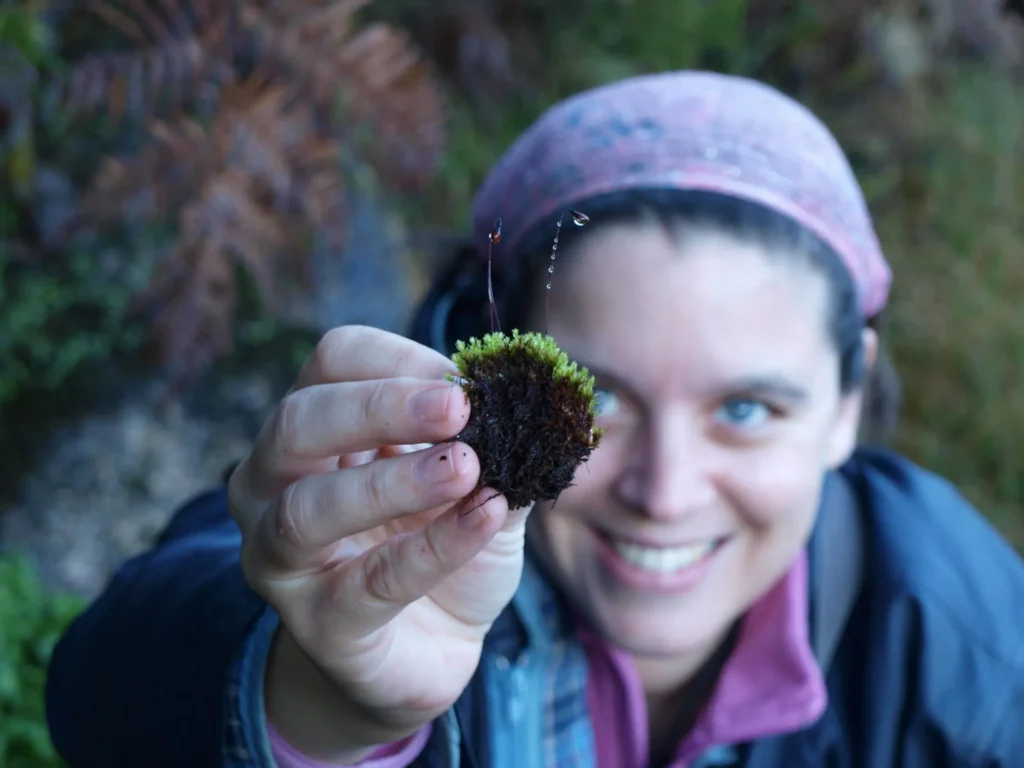
Nature has always been a safe and magical place, full of possible discoveries for me. The smallest organisms allowed the most unexpected discoveries and the plants were the permanent element of my life growing up on a farm.
I grew up without really knowing what I wanted to be “when I grew up”. At secondary school, I studied bryophytes and was enchanted by the detail of their shapes. At the University of Porto, in the Biology course, my favourite subjects were botany related and I loved to draw their cells and discover the life forms that had to survive without leaving the same place. In the third year, I chose the subject of mechanical dispersion of bryophyte spores as the subject of the practical classes’ report and I met my future seminary, internship, and PhD supervisor – Professor Ana Séneca. In the fourth year of the biology course, when the opportunity arose to study the phytosociology of hygrophilous and hydrophilous bryophytes of the National Park of Peneda-Gerês with my fellow botanist João Honrado, I realized that I had arrived at the “microhabitat” where I would be happy in science.
I started leafing through the floras of European and Iberian bryologists and memorizing forms and absorbing a new scale of life – when I returned from the field I brought back so many gifts wrapped in newspaper to discover that bryology became addictive in no time. In the early years, whenever I had specimens that were “impossible” to identify I would turn to the invaluable assistance of the experienced Dr Cecilia Sérgio, a calm and persevering inspiration who always supported and encouraged me to be a better bryologist and taught me the intricacies of the more difficult Genera and to understand the morphological plasticity of many aquatic species.
I was also very fortunate to have a friend-colleague-bryologist, Helena Hespanhol, and another friend-colleague-lichenologist, Joana Marques – and together, in the field or the lab, the exploration of briolichenic communities became our stimulus for journeys and discoveries. Meanwhile, our PhDs, post-docs, projects, students’ orientations, public visits, presentations, and organization of cryptogamic congresses followed one another – 20 years passed in a flash, always with many bryophytes, visits to national and international herbaria and friendships with other bryologist colleagues from all over the world.
In Bryology, my efforts were to know the list and distribution of species of watercourses, to use bryophytes for bioindication, to know and apply techniques of habitat restoration for the conservation of populations of bryophyte species, to contribute with data for the Red Lists of Bryophytes, and to contribute with data for ecological modelling.
Now I am the curator of the Herbarium of the Museum of Natural History and Science of the University of Porto (PO) and I have the privilege of caring for, studying, publishing data, and writing podcasts about some of the first Portuguese collections of bryology.
In the future, I hope to intensify my studies of Portuguese bryology and allow more and more access to bryological collections, but also continue to show and teach about the most fascinating organisms I know – bryophytes.
If you want to know more about my professional path you can check my page:
https://www.researchgate.net/profile/Cristiana-Vieira-2
List of selected publications:
Vieira, C., & Hespanhol, H. (2021). Writing the story of Porto herbarium and its botanists: 170 years of contributions to Iberian bryology. Boletin de la Sociedad Espanhola de Briologia. 52(53), 11.
Vieira C; Aguiar FC; Portela P; Monteiro J; Raven PJ; Holmes NTH; Cambra J; Flor-Arnau N; Chauvin C; Loriot S; Feret T; Dörflinger G; Germ M; Kuhar U; Papastergiadou E; Manolaki P; Minciardi MR; Munné A; Urbani? & Ferreira MT (2018) Bryophyte communities of Mediterranean Europe: a first approach to model their potential distribution in highly seasonal rivers. Hydrobiologia: Plants in Aquatic Systems 812 (1): 27-43.
Vieira C, Hespanhol H, Garcia C, Sim-Sim M, Sérgio C. 2016. Fluvial niche reconnaissance of noteworthy bryophytes in Portugal. Cryptogamie, Bryologie 37: 1-34.
Vieira C, Aguiar FC, Ferreira MT. (2014) The relevance of bryophytes in the macrophyte-based reference conditions in Portuguese rivers. Hydrobiologia 737 (1): 245-264.
Vieira C, Séneca A, Sérgio C & Ferreira MT (2012). Bryophyte taxonomic and functional groups as indicators of fine scale ecological gradients in mountain streams. Ecological Indicators 18: 98-107.
Sérgio C, Garcia C, Vieira C, Hespanhol H, Stow, S. (2013). Habitats and distribution in Portugal of three phytogeographically important species for the Iberian and European bryoflora. Boletin de la Sociedad Española de Briologia 40-41: 73-79.
Sérgio C, Garcia CA, Sim-Sim M, Vieira C, Hespanhol H, Stow S (2013) Atlas e Livro Vermelho dos Briófitos ameaçados de Portugal (Atlas and Red Data Book of Endangered Bryophytes of Portugal). MUHNAC. Lisboa. 464 pp. (book: ISBN: 978-989-8618-57-3).
Vieira C, Hespanhol H, Gonçalves J, Marques J & Bota A. (2012). Biological valuation in mountain landscapes as a tool for the conservation of bryophytes in Baixo-Tâmega, Portugal. Studia Botanica Hungarica 43: 69-84.
Vieira C, Séneca A, & Sérgio C (2004). The Bryoflora of Valongo – the refuge of common and rare species. Boletín de la Sociedad Española de Bríologia 25: 1-16.
A natureza sempre foi um local seguro e mágico, pleno de descobertas possíveis para mim. Os mais pequenos seres permitiam as descobertas mais inesperadas e as plantas eram o elemento permanente da minha vida ao crescer numa quinta.
Se quiser saber mais sobre o meu percurso profissional pode consultar a minha página:
https://www.researchgate.net/profile/Cristiana-Vieira-2
Cresci sem saber muito bem o que queria ser “quando fosse grande”. No liceu estudei as briófitas e fiquei encantada com o grau de detalhe das suas formas. Na universidade do Porto, no curso de Biologia, as minhas disciplinas preferidas eram as relacionadas com a botânica e encantava-me desenhar as suas células e descobrir as formas de vida que tinham de sobreviver sem sair do lugar. No terceiro ano escolhi o tema da dispersão mecânica dos esporos das briófitas como tema de relatório das aulas práticas e conheci a minha futura orientadora de seminário, estágio e doutoramento – a Professora Ana Séneca. No quarto ano do curso de biologia, quando surgiu a oportunidade de fazer o estudo da fitossociologia de briófitas higrófilas e hidrófilas do Parque Nacional da Peneda-Gerês com o colega botânico João Honrado percebi que tinha chegado ao “micro-habitat” onde iria ser feliz na ciência.
Comecei a folhear as floras de briólogos europeus e ibéricos e a memorizar formas e a absorver uma nova escala de vida – quando voltava do campo trazia tantos presentes envolvidos em jornal para descobrir que a briologia se tornou viciante em pouco tempo. Nos anos iniciais, sempre que tinha espécimes “impossíveis” de identificar recorria ao auxílio precioso da experiente Drª Cecília Sérgio, uma inspiração calma e perseverante que sempre me apoiou e encorajou a ser melhor brióloga e me ensinou os meandros de Géneros mais difíceis e a compreender a plasticidade morfológica de muitas espécies aquáticas.
Também tive a grande felicidade de ter uma amiga-colega-brióloga, Helena Hespanhol, e outra amiga- colega-liquenóloga, Joana Marques – e juntas, no campo ou no laboratório, a exploração das comunidades brioliquénicas passou a ser o nosso estímulo para viagens e descobertas. Entretanto os nossos doutoramentos, pos-docs, projectos, orientações de alunos, visitas com público, e apresentações e organização de congressos criptogâmicos sucederam-se – 20 anos passaram-se num ápice, sempre com muitas briófitas, visitas a herbários nacionais e internacionais e amizades com outros colegas briólogos de todo o mundo.
Na Briologia, os meus esforços foram no sentido de conhecer a lista e distribuição das espécies dos cursos de água, de usar briófitas na bioindicação, de conhecer e aplicar técnicas de restauro de habitats para a conservação de populações de espécies higroturfosas, de contribuir com dados para as espécies das Listas Vermelhas das Briófitas, de conseguir contribuir com dados para modelação ecológica.
Agora sou curadora do Herbário do Museu de História Natural e da Ciência da Universidade do Porto (PO) e tenho o privilégio de cuidar, estudar, publicar dados e escrever podcasts sobre algumas das primeiras coleções portuguesas de briologia portuguesa.
No futuro espero intensificar os meus estudos de briologia portuguesa e permitir cada vez mais o acesso às coleções briológicas, mas também continuar a mostrar e ensinar sobre os seres mais fascinantes que conheço – as briófitas.