
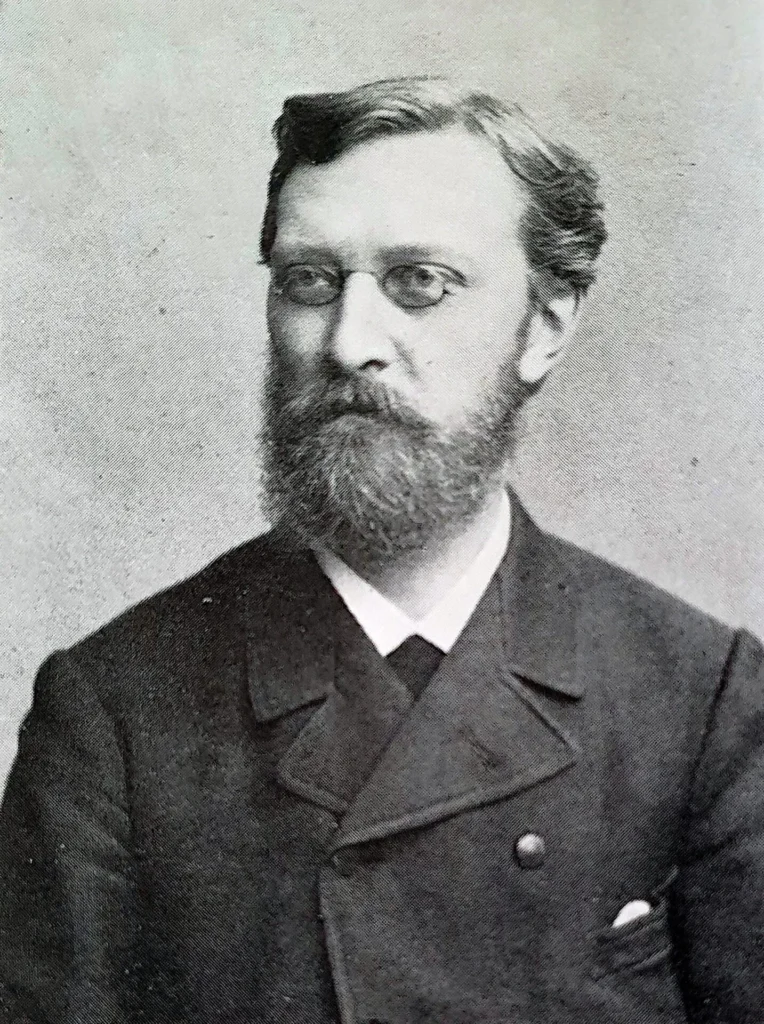
Franz Stephani was born in Berlin on 15 April 1842 and died on 23 February 1927. Although he never followed a formal university career in botany, he became one of the most prolific and influential specialists of liverworts and hornworts of his time. Trained initially for a commercial career, he worked in several professions before devoting an increasing part of his life to hepaticology.
Stephani’s interest in liverworts developed relatively late, and the precise origins of this passion remain unclear. For professional reasons, he travelled widely in Europe and spent two years in New York in the 1860s. After returning to Germany, he lived first in the Erzgebirge and, from 1880 onwards, in Leipzig, leaving the country only occasionally, mainly for holidays in the Alps or in the mountains of Thuringia.
Through his intensive work on liverworts, Stephani became, for a time, one of the leading authorities in the field. He accumulated a herbarium of worldwide importance and was in contact with many botanists and collectors. His most ambitious work was Species Hepaticarum, published between 1898 and 1925 in six volumes. This monumental synthesis attempted to treat all known liverworts and hornworts of the world. It included almost 10,000 species names, more than 4,000 of which were newly described by Stephani himself. No comparable global treatment of the group had previously been attempted.
The history of Species Hepaticarum is closely linked with the Boissier Herbarium in Geneva. In 1897, an agreement was signed between Stephani and the Boissier Herbarium for the publication of the complete work. Under this agreement, Stephani’s herbarium, library, notes, drawings, scientific correspondence and even his microscope were to be deposited in Geneva. The collections arrived there in 1914 and included about 11,000 specimens, now forming a key resource for the study of the many names published by Stephani.
Stephani’s legacy is both major and complex. His work greatly stimulated the study of liverwort diversity and made an enormous amount of material and nomenclatural information available to later researchers. At the same time, Species Hepaticarum has long been considered a difficult and problematic work, because many of the species described by Stephani were based on limited material, later proved to be synonyms, or created nomenclatural and taxonomic confusion. For this reason, modern hepaticologists have had to devote considerable effort to revising his names and typifications. Nevertheless, his herbarium and unpublished drawings, especially the Icones Hepaticarum, remain essential for resolving many of these taxonomic problems.
Today, Franz Stephani is remembered as one of the most remarkable figures in the history of hepaticology: not a university botanist, but an extraordinarily productive private scholar whose work shaped the taxonomy of liverworts for more than a century. His collections in Geneva continue to be of great importance for bryological research, and his name remains inseparable from the history of liverwort systematics.