
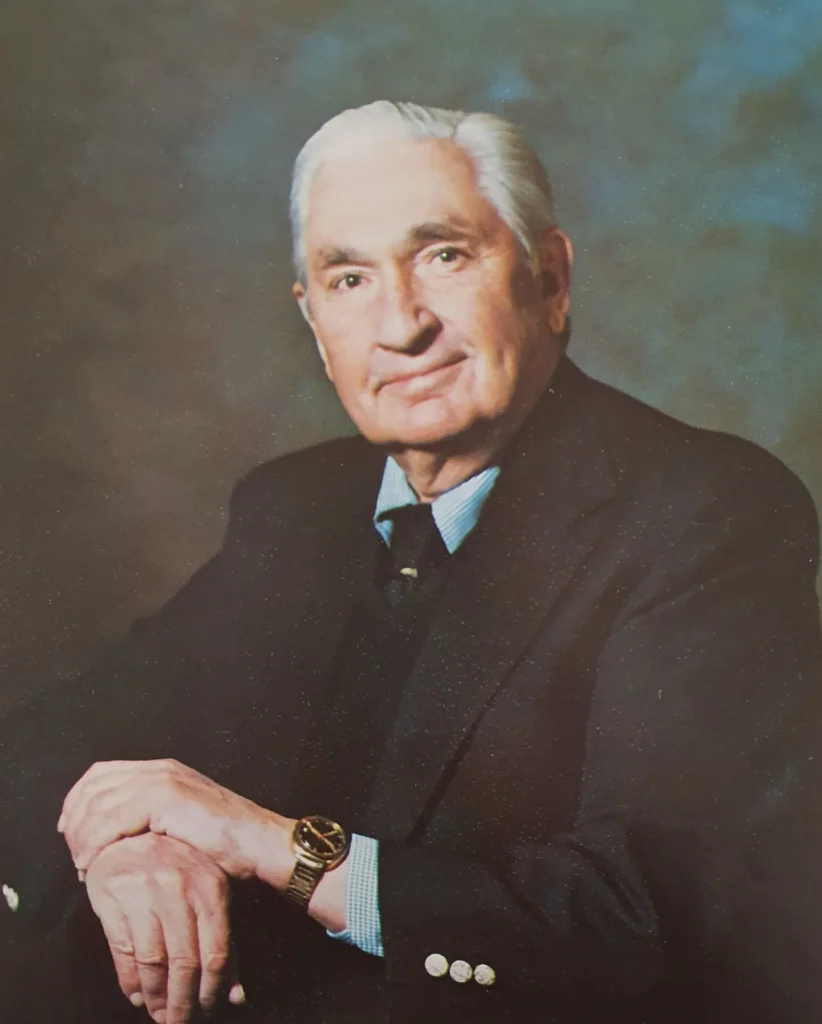
William Campbell Steere (1907–1989), known as Bill Steere, born November 4, 1907, in Muskegon, Michigan, came from a long line of pioneering naturalist Irish-Quaker ancestors. His paternal grandfather, Joseph Beal Steere, was a professor of zoology and paleontology at the University of Michigan and was the principal influence on Steere’s subsequent interest in and pursuit of a botanical career.
William Campbell Steere graduated with “high distinction” from the University of Michigan in 1929 with a B.S. in Botany. He was awarded an M.A. in 1931 and a Ph.D. in 1932. Joining the faculty in Ann Arbor, Dr. Steere progressed through its ranks to Full Professor in 1946 and was appointed Chair of the Botany Department in 1947.
While his early research and publications were on phanerogamic cytology, Dr. Steere’s fascination with bryophytes, mosses in particular, was formed during his second year as a university student while working as a lumberjack in Oregon (“I was attracted by the beautiful mosses of the woods.”). Soon after receiving his doctorate, he focused his research on bryology, a relatively unexplored field in 1930s North America. From 1938 to 1942, and again from 1945 to 1946, Steere taught field courses in bryology and systematic biology, concentrating on Michigan’s Upper Peninsula. Other highlights of his career during this period include leading a biological survey of the Maya Region of the Yucatan in 1932; serving as an exchange professor at the University of Puerto Rico in 1935, where he developed a large collection of mosses that provided the basis for Mosses of Puerto Rico and the Virgin Islands — co-authored with Howard Crum; and leading expeditions, from 1942 to 1946, to locate and develop Cinchona plantations in Latin America and provide alternative sources of quinine for the United States during World War II. He also managed to find time to collect bryophyte specimens, although they would remain uncatalogued into the last decade of his life.
He also led field parties to Great Bear Lake in Canada’s Northwest Territories in 1948 and to Alaska in the summer of 1949 to study the effects of naturally occurring radioactivity on plant life. These two forays introduced Steere to the world of Arctic bryophytes, which he would continue to explore from the 1950s until the early 1970s.
Professor Steere left the University of Michigan at Ann Arbor for Stanford University in 1950. He remained at Stanford until 1954, when he accepted a one-year position with the National Science Foundation as Program Director in Systematic Biology. Steere returned to Stanford University in 1955 as Dean of Graduate Studies. He also continued to teach, advise doctoral candidates in the field of bryology, and gather specimens of Arctic bryophytes.
In 1958, Dr. Steere accepted the position of Director at the New York Botanical Garden. During his tenure at the Garden, Steere was able to reinvigorate and maintain the Garden’s tradition of excellence in science. In the midst of these responsibilities, Dr. Steere continued to pursue his own rigorous research, publishing, and public speaking activities, while following the careers of his former students and encouraging yet another generation of bryologists. Steere also played a pivotal role in international scientific cooperation. The recipient of numerous awards, he was active in a variety of scientific societies in the United States, Europe, and South America. Because of the relationships between the Japanese flora and the floras of eastern North America, Alaska, and the Pacific Northwest, his special focus was Japan.
In 1966, an informal discussion at the Pacific Science Congress in Tokyo resulted in the establishment of an organizing committee consisting of William “Bill” C. Steere (U.S.A.) as chairman, and Stanley W. Greene (U.K.) and Zennoske “Zen” Iwatsuki (Japan) as vice-chairmen. The task of the committee was to draw up plans for the proposed International Association of Bryologists (IAB), prepare a preliminary address list, and draft a constitution. After three years of preparatory work, the proposal to formally establish the IAB was put forward by Bill Steere at a special meeting of the American Bryological Society in Seattle, U.S.A., in late August 1969, on the occasion of the 11th International Botanical Congress. The motion to establish the new association was carried unanimously. At this meeting in Seattle, the secretary-general of the International Association for Plant Taxonomy (IAPT), Frans Stafleu (Utrecht, The Netherlands), proposed placing the IAB under the wing of the IAPT. The first executive committee of the IAB was born, with Bill Steere as president, Stanley Greene as vice-president, Zen Iwatsuki as second vice-president, and Rob Gradstein as secretary.
Dr. Steere relinquished his duties as Director of the New York Botanical Garden in 1973, assuming the title of Senior Scientist. He formally “retired” in 1977. As Senior Scientist and President Emeritus, however, Dr. Steere maintained an office at the Garden and continued his work in bryology until his death on February 7, 1989.
This biography was compiled from the New York Botanical Garden and IAB history (Gradstein, 2014)