
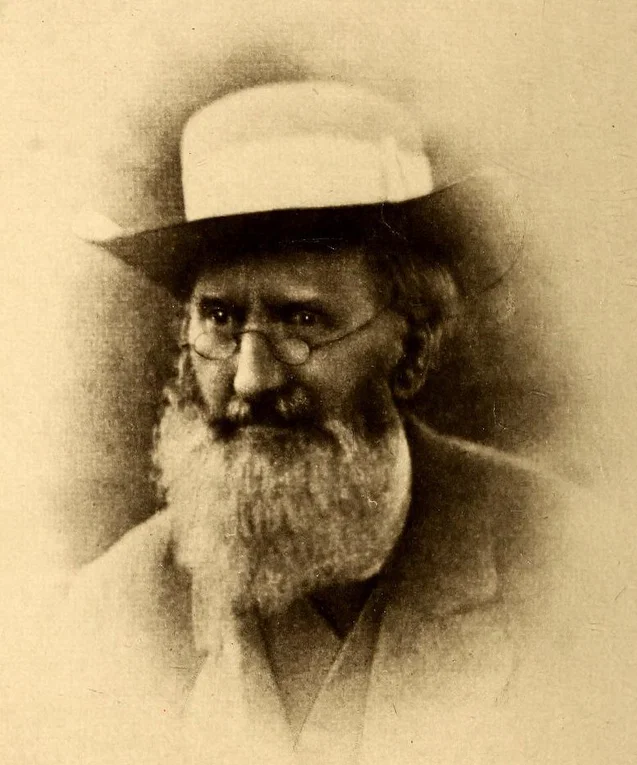
Richard Spruce was one of the great nineteenth-century botanist-explorers and one of the most important figures in the history of tropical bryology. Although he is less widely known than some of his contemporaries, his collections, observations and publications made a lasting contribution to the study of South American plants, especially liverworts. His work combined classical taxonomy, field exploration, economic botany and what would now be called ethnobotany.
Spruce was born at Ganthorpe, near Terrington and Castle Howard in North Yorkshire, and was baptised on 10 September 1817. He was the son of Richard Spruce, a schoolmaster, and Ann Etty. His mother died when he was still young, and his father later remarried Mary Prest. Like his father, Spruce first entered the teaching profession. He studied Latin and Greek with an old schoolmaster named Langdale, taught at Haxby from 1839, and by 1841 was working as an assistant master at York Collegiate School, where he remained until 1844.
From an early age, however, his main passion was natural history. By the 1830s he had already begun to study the flowering plants of his native district. In 1834, at the age of sixteen, he prepared a list of 403 species from around Ganthorpe. In 1837 he compiled a flora of the Malton district, recording 485 species of flowering plants. These early works already show the qualities that would characterize his later career: patience, precision, and an extraordinary capacity for observation.
By the early 1840s, Spruce turned to bryology and had become an accomplished bryologist. He was helped in his early bryological work by Samuel Gibson of Hebden Bridge and soon became connected with some of the leading British botanists of the period. Around 1841 he found Myrinia pulvinata and several other bryophytes new to Britain. His excursions in Yorkshire, especially in Teesdale, added many records to the local and national flora. In 1842 he travelled to Ireland, where he stayed with Thomas Taylor, one of the leading bryologists of the time, and studied his herbarium. His early publications, including “Mosses of Eskdale” in the Phytologist in 1844 and “On several mosses new to the British Flora” in the Journal of Botany in 1845, established his reputation as a serious and gifted botanist.
With the support of botanists such as William Borrer, Sir William J. Hooker and George Bentham, Spruce undertook a major collecting expedition to the Pyrenees in 1845–1846. The journey was intended partly to provide sets of dried plants for sale, but it also gave him the opportunity to explore a bryophyte flora that was still poorly known. He collected 478 species of bryophytes, 17 of them new to science. His account, Musci and Hepaticae of the Pyrenees, published in 1849, was an important contribution to European bryology. Despite his delicate health, this expedition revealed his remarkable endurance and prepared the way for the much larger journey that would define his life.
In 1849, convinced that his chronic bronchial problems might develop into tuberculosis, and determined to see and collect in tropical rainforest before it was too late, Spruce sailed for South America. He remained there for fifteen years, until 1864. His task was to explore the flora of the Amazon basin and send collections to Kew Gardens. His travels took him up many tributaries of the Amazon, through the Rio Negro region, across the Casiquiare towards the Orinoco, and later into the Andean regions of Peru and Ecuador. He met Alfred Russel Wallace at Santarém and continued into regions that were extremely difficult to access, even by modern standards.
The Rio Negro was one of the regions that most fascinated him. There he collected many plants new to science in an area still recognized today as exceptionally rich botanically. From 1855 onwards he worked in the upper waters of the Amazon and in the northern Andes. He stayed at Tarapoto, travelled to Canelos in Ecuador, and later worked around Ambato and Chimborazo. Some of these journeys were extremely arduous. His route to Canelos, by way of the Pastaza, took fourteen weeks, and part of his baggage was lost or abandoned in swollen torrents and waterfalls. Yet the Andean foothills, especially Tarapoto and the forests of Baños, yielded some of the richest bryophyte collections of his whole career.
Spruce’s work also had major economic importance. He contributed to knowledge of Hevea, the source of natural rubber, and played a decisive role in the history of Cinchona, the source of quinine, then the only known effective remedy against malaria. Commissioned by the British authorities, he located and studied the best Cinchona forests in Ecuador and collected seeds and young plants for shipment to Kew and then to British colonies in Asia. The work was difficult and dangerous: he had to identify the best trees, negotiate with local authorities and landowners, wait for ripe seed, raise seedlings and arrange their export. He eventually succeeded in sending about 100,000 seeds and 637 young plants. These shipments helped establish the quinine industry in India and Ceylon, with immense consequences for the treatment of malaria. Spruce himself, however, received only a modest pension for this work.
His years in South America permanently damaged his health. He suffered from chronic intestinal disease and, to make matters worse, lost almost all his savings when an Ecuadorian bank collapsed in 1861. Nevertheless, he continued to explore the Pacific coastal regions of Ecuador and Peru for several more years before returning to England in May 1864, after an absence of almost exactly fifteen years.
Back in Yorkshire, Spruce lived in poor health, first around Welburn and later at Coneysthorpe. Though often described as a chronic invalid, he continued to work intensively on his collections. His South American material was immense: about 7,000 species of angiosperms, as well as palms, ferns, mosses, liverworts, lichens and fungi. His study of palms led to the publication of Palmae Amazonicae in 1869, in which he characterized 118 species, more than half of them new to science. His moss collections were studied by William Mitten and became an important source for later work on South American bryophytes.
It was, however, in the liverworts that Spruce made his greatest scientific contribution. His monumental Hepaticae Amazonicae et Andinae, published in 1884–1885 in the Transactions of the Botanical Society of Edinburgh, described more than 700 species, nearly 500 of them collected by Spruce himself and almost 400 new to science. It remains one of the foundational works of South American bryology and one of the great achievements of nineteenth-century bryological research.
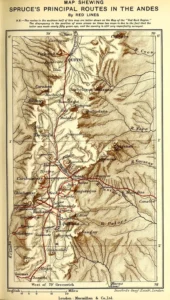
Spruce was much more than a collector and taxonomist. He was an exceptionally attentive observer of the peoples and environments he encountered. He recorded the uses of plants by Amazonian and Andean communities, noted customs and social practices, made maps of poorly known rivers, sketched villages and landscapes, and studied languages. He recorded vocabularies from numerous Amazonian dialects and observed plant use in ritual and medicine. His investigation of the narcotic drink known as caapi, later associated with Banisteriopsis caapi, is a striking example of his early ethnobotanical insight.
After his death, Alfred Russel Wallace edited Spruce’s Notes of a Botanist on the Amazon and Andes, published posthumously in 1908. This work helped bring wider attention to the range and depth of Spruce’s observations. In the twentieth century, Richard Evans Schultes further emphasized Spruce’s importance, especially for ethnobotany, economic botany and the study of tropical South American plants.
Richard Spruce died unmarried at Coneysthorpe on 28 December 1893 and was buried at Terrington beside his parents. His specimens are now preserved in major herbaria including Kew, the Natural History Museum in London, Glasgow, Manchester Museum and Harvard; his letters, manuscripts, diaries and drawings are held in several British institutions.
Although he worked with fragile health, limited means and often in isolation, Spruce left an extraordinary scientific legacy. For bryologists, he remains above all one of the greatest students of tropical liverworts. More broadly, he stands as a model of the nineteenth-century naturalist: exact, courageous, intellectually wide-ranging, and capable of seeing plants not only as specimens, but as part of landscapes, cultures and human lives.
References
Lawley Mark RICHARD SPRUCE (1817-1893) on the BBS website
Seaward Mark R.D. (2010) Richard E. Schultes and the Botanist-Explorer Richard Spruce (1817–1893) Harvard Papers in Botany, 15(2):447-454