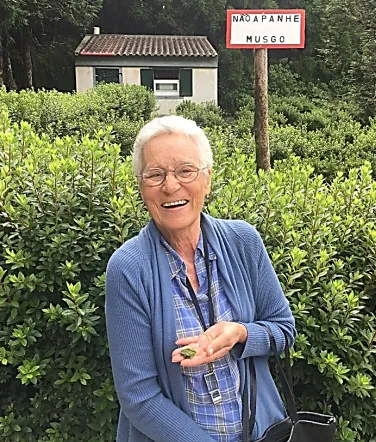
I was born in 1944 in a small town near Aveiro city on the oceanic border, in the north of Portugal, with a vast lagoon where the freshwater of the River Vouga joins with the sea. The city is crossed by canals, genuine streets of water, along which can be seen natural sites with salt-marshes and pyramids of white salt. My house, where I lived with my parents and two brothers, was near a small canal in a coastal salt marsh area adjacent to the river. I had a chance to share nature and pass good moments with friends by maritime vegetation. It was like living in the countryside within a city. Ever since I was a young child I have enjoyed nature; for me it is truly irresistible.
After seven years in a National Lyceum (secondary school) I obtained the grades to go to Coimbra University to study Biology. The four years that I spent at University coincided with a very critical and dark period in Portuguese history; a dictatorship and an authoritarian regime, and we lived with strikes and even policing at the University. The academic crisis in 1962 (“Student Springs”) was a very prominent event for me, with colleagues detained for political views. It was the beginning of a movement that promised freedom from a long period of political repression. Nevertheless, against this backdrop, my interest in botany flourished, and I completed my studies with excellent results.
One month after finishing Biology at Coimbra University (1964) I was invited to take up a position as Naturalist Assistant at the Botanic Garden, where I had completed my degree. I got married in 1965 but I was concerned that I might have to accompany my husband to the colonial wars in Africa. Fortunately, this was not necessary to go anywhere with the Portuguese war overseas, but he had to take the Captain’s course and was in first arrange to go to Angola for 2 years, if it weren’t for the 25th of April 1974 that helped us all. In time I had two children, and today I have five grandchildren.
So my professional career began in 1965 as Assistant Naturalist, after in 1966 as Naturalist in Coimbra University. The bryophyte collection of (COI herbarium) was completely disorganized, with packages and packages still to be opened from offers and exchanges. It comprised limited recent collections, excluding the offers from Paris herbarium (PC) with the three Exsiccatae of Bryotheca Ibérica and one of Bryotheca Azorica.
It was really invaluable to partake in this adventure, which served as a motivation to dedicate myself to bryology. In Serra do Bussaco I talked and talked with Valia Allorge and we both showed a keen interest in cooperating with each other. On this expedition we also went to Serra do Caramulo where I collected samples of bryophytes for the first time, processing around 20 specimens, all of which are now incorporated in the COI herbarium. It was an important and inspirational lesson in bryology for me, and I never ceased supporting her with her work up to her death in 1977.
In mid 1965, this contact with a seventy year old Madame Allorge, very coquettish and alone at a Palace Hotel in Bussaco, was an eye opener for a beginner like me. This contact also opened the doors for collaboration with the bryology team at the Museum de Histoire Naturelle in Paris, with Suzanne Jovet-Ast and later with Hélène Bischler and Denis Lamy. Furthermore, as consequence of the contact during the field trip to Bussaco I became aware of the important work on the bryophytes of the Azores, which Valia published with her husband Pierre Allorge in 1937, a subject that especially interested me, and at about the same time he published the “Bryophytes de matelas” (Allorge 1937).
The work in Coimbra continued, and much was accomplished, always with kind support from all colleagues. However, with my marriage in 1965 and after the birth of two children, there was some slowdown in my scientific endeavours, though I managed to publish around 9 articles and collected more than 1300 samples that today are in the Coimbra herbarium (COI) more or less studied.
Subsequently, after five years at the Coimbra Botanical Garden, I came to live in Lisbon. Firstly, from 1971 to 1979, I worked as a Naturalist at the University of Lisbon, but after 1997, I was a Principal Investigator at the Faculty of Sciences and the Natural History Museum of the University of Lisbon. In 2006, I passed for Coordinating Researcher at the same University, a position I held until 2011.
Currently retired, but still active as a researcher at the Research Centre in Ecology and Evolution (CE3C), with a protocol also approved by the National Museum of Natural History and Sciences, University of Lisbon.
I consider myself a specialist in Bryology, having dedicated myself to research in this area since 1965, mainly concerning the Bryoflora of the Iberian Peninsula and Macaronesia, including taxonomic, floristic, ecological and phytogeographic studies, focusing primarily on environment processes, such as those related to climate, pollution monitoring and conservation. My interest in understanding the diversity and evolution of bryophytes led me to the discovery of some bryophytes new for science, such as Thamnobryum fernandesii in Madeira or the mysterious Aneura mirabilis a new species for Portugal and the Iberian Peninsula. In total I have described 15 new taxa some distributed to Europe, Mediterranean area and Tropical Africa.
In support of this activity since 1965, I have been able to participate in field explorations, mainly on the Portuguese mainland and in the archipelagos, but also in various regions of the Iberian Peninsula, Europe but also in Mediterranean area and Africa, having collected more than 50,000 herbarium specimens. Based on this collected material, or on reviews of herbarium specimens from different national and international institutions. Currently, I am directing my studies towards topics related to tropical flora, given the lack of knowledge in bryophytes in these areas. The study of bryophytes on the islands of Cape Verde and São Tomé and Príncipe stands out, with the discovery of some new species to the Atlantic Islands.
In another context, but not related to Fundamental Research studies, I have focused on more applied themes, specifically adapted to original topics with different methodologies, such as pollution monitoring and habitats conservation. The work is closely linked to the conservation of bryophytes from the Iberian Peninsula and at the European level, assisting in the selection of areas and species of biological interest (Natural Habitats Directive, Berne Convention). Thus, it has led to projects linked to the conservation and monitoring of biodiversity, and has also culminated in Red Lists of Portugal, the Iberian Peninsula and Europe, to the implementation of standards to minimize the loss of biodiversity. In addition to these areas of study, my interests have also been directed to topics related to the biomonitoring of ecological quality of anthropogenic areas, obtaining data on water pollution, fire environmental impact and quantifying the deposition of heavy metals in the environment.
Some new approaches to bryophyte diversity in Iberian area were pointed, as distributions of selected species in the Atlas of the Iberian Peninsula and Macaronesia, with the support of the Institut d’Estudis Catalans. I collaborated in the preparation of biodiversity data and in obtaining distribution patterns and areas for modelling the occurrence of bryophytes, based on computational analyses and GIS, and in predicting the distributions of bryophytes important for conservation and climatological purposes.
For all this, I had the support of more than 50 national/international scientific projects, in which I was the principal research. But always with the support of excellent collaborators and students, it was possible to carry out the publication of more than 450 articles in national and international journals, of which 50 are books or are part of book chapters.
Experience in teaching and scientific guidance
With regard to classes and teaching support, since 1979 I have taught various subjects, internships, and in doctoral and master’s programs in Plant Biology at the Faculty of Sciences of Lisbon, as well as in postdoctoral projects taught at the Faculties of Porto and Coimbra, and at the University of Madeira, including temporary collaborations with foreign students..
 Additional helps for scientific career
References of publications