
IAB
I hold a MSc degree in Animal Ecology from Marburg University, Germany from 2009. You may wonder why I am now writing for this project organised by the IBA. Well, my passion for the inconspicuous yet beautiful and important plants developed shortly after this…in Wales! I moved here, to Bangor, to start my PhD entitled “Nitrogen dynamics in boreal forests”. Still no bryophytes? Well, I chose to focus on a process in the nitrogen cycle that takes place in mosses: nitrogen fixation performed by cyanobacteria that colonise mosses.
During my PhD, I went to boreal forests in Northern Sweden to collect mosses – specifically the very common moss Pleurozium schreberi which forms thick and expansive moss carpets in these northern, cold forests, wow! This was overwhelming for me, coming from central Germany where deciduous forests have little moss cover.
Working with P. schreberi, I identified the effects of increased nitrogen availability and drying events as well as heavy metal pollution on moss-associated nitrogen fixation. Following my PhD (from 2013), I started as a postdoctoral fellow at the University of Copenhagen, working further on moss-associated nitrogen fixation in arctic ecosystems and trying to identify how climate change will impact this process in the Arctic. Nitrogen fixation performed by cyanobacteria on mosses can contribute half to total ecosystem nitrogen input, hence, any impacts on this process will affect the entire ecosystem.
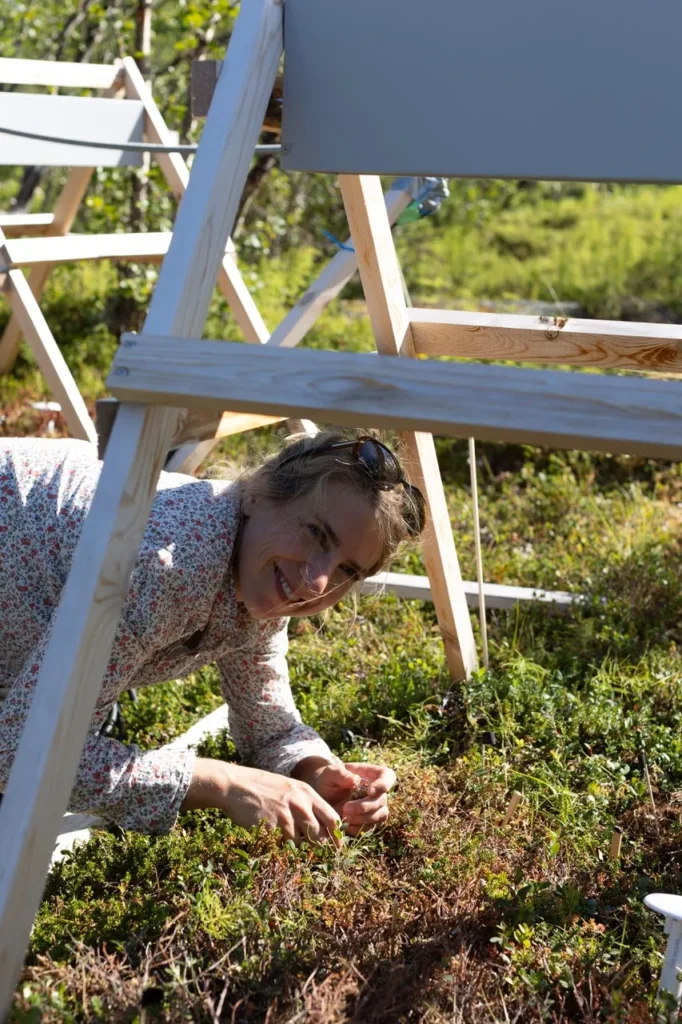
Since 2019, I am a tenure-track assistant professor in terrestrial ecology at the University of Copenhagen. Here, I am leading the Ecosystem Ecology group, focussing on moss-cyanobacteria associations and nitrogen fixation. The group is a mix of BSc, MSc, PhD students and postdocs with different backgrounds but all fascinated by mosses and associated bacteria. With starting grants from the Danish Research Council and the European Research Council, we aim to identify the effects of climate change on nitrogen fixation in mosses across ecosystems (arctic, boreal, temperate, tropical) as well as to determine the nature of the relationship between mosses and associated cyanobacteria. For this, we employ laboratory-based assessments as well as field work across the globe. We work with many different moss species now, and it seems like all mosses are colonized by these versatile cyanobacteria, but to varying extents – certain moss traits determine who is there and how many! We also aim to promote research within bryology, trying to highlight the importance, beauty and wonder of bryophytes.
Ich bin in einem kleinen Ort nördlich von Marburg geboren und aufgewachsen – von Wäldern und Bergen umgeben. An der Universität in Marburg habe ich dann auch studiert und meine Diplomarbeit (Master of Science) in Tierökologie in 2009 geschrieben.
Ich bin nach Bangor in Wales gezogen um hier meine Doktorarbeit zu schreiben. Das Thema war “Stickstoff Umwandlungen in borealen Wäldern”. Immer noch keine Bryophyten?
If you want to read more about our research, check our homepage:
https://www1.bio.ku.dk/english/research/te/ecosystem-ecology/
See the story of Kathrin Rousk’s research in writing and visuals
Alvarenga DO, Rousk K (2022) Unraveling host-microbe interactions and ecosystem functions in moss-bacteria symbioses. Journal of Experimental Botany, in press
Rousk K, Pedersen P, Priemé A, Michlesen A (2021) Extreme freeze-thaw cycles do not affect moss-associated nitrogen fixation across a temperature gradient, but affect nutrient loss from mosses. Acta Oecologia, 113, 103796
Permin A, Michelsen A, Rousk K (2021) Direct and indirect effects of warming on moss abundance and associated nitrogen fixation in subarctic ecosystems. Plant and Soil, https://doi.org/10.1007/s11104-021-05245-9
Liu X, Rousk K (2021) The moss traits that rule cyanobacterial colonization. Annals of Botany, mcab127, https://doi.org/10.1093/aob/mcab127
Lett S,…Rousk K… et al. (2021) Can bryophyte groups increase functional resolution in tundra ecosystems? Arctic Science, https://doi.org/10.1139/as-2020-0057
Alvarenga DO, Rousk K (2021) Indirect effects of climate change inhibit N2 fixation associated with the feathermoss Hylocomium splendens in subarctic tundra. Science of the Total Environment, 795:148676
Aber wie bin ich von Tierökologie auf Moose gekommen? Meine Faszination mit den unscheinbaren, leicht zu überschauenden, aber wunderschönen Pflanzen hat sich kurz nach meinem Diplomabschluss entwickelt…und das ist in Wales passiert!
Ich konnte mir aussuchen woran ich arbeite, und habe mich für einen Prozess im Stickstoffkreislauf entschieden der in Moosen passiert: Stickstofffixierung bei Cyanobakterien die Moose besiedeln.
In meiner Doktorarbeit bin ich zu borealen Wäldern in Nord Schweden gereist um Moose zu sammeln- insbesondere das sehr häufige Moos Pleurozium schreberi dass hier in diesen kühlen, nördlichen Wäldern dichte, dicke und weitläufige Matten formt, wow! Das war sehr überraschend für mich, da wo ich her komme, aus der Mitte von Deutschland, Laubwälder vorherrschen in denen nicht viele Moose auf dem Boden wachsen.
Durch meine Forschung an P. schreberi habe ich herausgefunden wie sich z.B. Verschmutzung durch Schwermetalle, zu viel Stickstoff und zu wenig Feuchtigkeit auf die Stickstofffixierung bei Cyanobakterien auf Moosen auswirken. Nach meiner Doktorarbeit (von 2013) habe ich an der Universität in Kopenhagen als Postdoc angefangen, wo ich weiterhin mit Stickstofffixierung in Moosen, aber nun in der Arktis, arbeiten konnte. Hier habe ich mich auf die Auswirkungen des Klimawandels konzentriert. Stickstoffifxierung bei Cyanobakterien die Moose besiedeln kann mehr als die Hälfte zum Stickstoffgehalt in Ökosystemen beitragen und wenn sich dieser Prozess verändert, durch z.B. Klimawandel, wird das ganze Ökosystem betroffen sein.
Seit 2019 habe ich eine Stelle als „Tenure-Track Assistant Professor“ in Terrestrischer Ökologie an der Universität in Kopenhagen. Hier leite ich die „Ökologie von Ökosystem“ Arbeitsgruppe wo wir uns auf das Zusammenspiel von Moosen und Cyanobakterien und Stickstofffixierung konzentrieren. Meine Gruppe besteht aus einem Mix aus Bachelor und Master Studenten, Doktoranden und Postdocs mit verschiedenen Hintergründen und Interessen, wir sind aber alle fasziniert bei Moosen und ihren Bakterien.
Mit Forschungsgeldern für junge Gruppenleiter von Dänischen und Europäischen Forschungsgesellschaften können wir nun viel mehr forschen, z.B. wie der Klimawandel die Stickstofffixierung in Moosen in verschiedenen Ökosystems (Arktis, Boreale-, gemäßigte-, tropische Wälder) beeinflusst, ob Moose und Cyanobakterien einen Vorteil von ihrem Zusammenleben haben usw. Um das alles herauszufinden führen wir Experiment im Labor und in der Natur durch. Wir arbeiten mit vielen verschiedenen Moosarten, und es scheint so als wären alle Moose mit Cyanobakterien besiedelt aber in unterschiedlichem Ausmaß –Eigenschaften der Moose bestimmen wer und wie viele Bakterien da sind.
Mit unserer Forschung wollen wir auch die Beudetung, Schönheit und Faszination die Moose und andere Bryophyten haben fördern und hervorheben.