IAB
My passion for bryology started on quite an unusual path.
I was born in a small village in the east of France. As a child, I was already very close to nature; I enjoyed observing the little ferns and mosses on the old walls along the river.
After my high school final exam, I worked in the medical field, as a technician in a cytogenetic laboratory. There I began to enjoy using a microscope to observe cells and chromosomes for hours.
I have lived in the French West Indies for about 40 years.. I continued my career as a bio technologist in cytogenetics in Martinique and then in Guadeloupe: first in cytogenetics, then in molecular biology, for the screening of sickle cell disease and thalassemia.
However, at the weekend, I often went with my husband to explore the rainforest trails and began to look at bryophytes with increasing interest at each outing, feeling attracted by their somewhat mysterious aspect.
I had little literature available concerning the bryoflora of these islands, except for the cryptogamic flora of Reverend Father Duss (1901) and a bryological flora of Guadeloupe elaborated by a student in 1970. Then, as I was able to have access to the flora of the mosses of Mexico (ref) and to get a small microscope, I started a herbarium of bryophytes.
I was discouraged more than once, not being accustomed to using the bryophyte keys. Yet over the years, thanks to tenacity, and passion, I held on. And in 2009, I was contacted by the environmental department of Guadeloupe and the National Forestry Office of Guadeloupe and Martinique to assess the bryophyte flora of Guadeloupe and Martinique. It was a great opportunity to improve my knowledge of bryophytes. Numerous field trips, as well as data collected in the literature have led in 2011, with the collaboration of Mr. Alfons Schäfer Verwimp to the publication of a checklist of bryophytes of these islands.
Fortunately, I could retire early enough, which enabled me to indulge in my bryological research, as a member of the Guadeloupe Botanical Conservatory, by exploring many sites in Guadeloupe and Martinique during various studies:
From then on, I continued to search in the existing literature, to obtain other flora and publications, and spend time using the microscope. I was discouraged more than once, not being used to using the keys.
Several authorities of Guadeloupe and Martinique (the Regional Directorate for the Environment, Planning and Housing, the National Forestry Office, the National Park of Guadeloupe) trusted me and solicited me in the context of various studies:
In Guadeloupe
– Study on the status of the bryophyte flora of the French West Indies Guadeloupe and Martinique
– Study of the bryophyte flora of the managed biological reserveof Nord Grande-Terre (National Forestry Office)
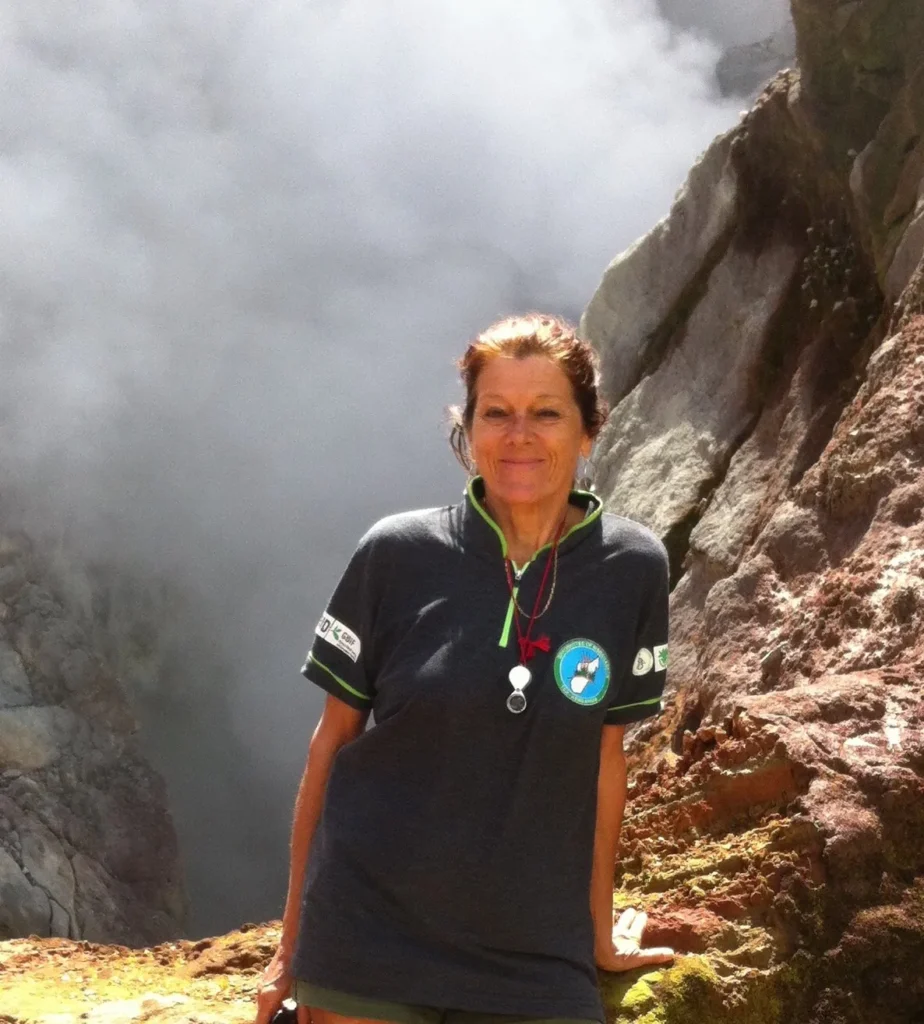
– – Study of bryophytes as indicators of climate change, bryophytes collected along an altitudinal gradient on the Soufrière volcano, (MOVECLIM project) http://moveclim.blogspot.com/
– – Study of the bryophyte flora as part of a floristic and faunistic impact study on a water intake development site.
– Inventories of bryophytes during ZNIEFF programs (Natural Areas of Ecological, Faunistic and Floristic Interest)
In Martinique
All these studies have strengthened my passion for these plants, their esthetic expression, under the microscope as well as in the field, always producing a constant source of astonishment and wonder!
They allowed me to visit the New York Botanical Garden several times (2009, 2010 et 2013) to work on the bryophyte collections of the French West Indies of RP Duss. There, I met Bill Buck and Barbara Thiers who kindly helped me with the identification of some of my samples. When I went to the National Museum of Natural History, in Paris, I met Professor Jacques Bardat and Professor Robbert Gradstein who encouraged me to carry on with my research. Since then, we have established a friendly relationship and I appreciate his being available whenever I need help with determinations.
Bryology also allowed me to meet my friend Catherine Reeb (MNHN). We are working a lot together on the Marchantiophytes of the French West Indies and we “tracked down” the Riccardia and Riccia of Guadeloupe during her stays on the island. Thanks to her I could join the Madbryo working group and participate, in a workshop in Madagascar, in 2018. It was a great opportunity to meet eminent bryologists, to explore some beautiful Malagasy forests and I was proud to bring my contribution in bryology for the training of young Malagasy students.
Living in Guadeloupe is an advantage because the island is relatively small (1700 km2) and includes a large floristic diversity due to the bioclimatic gradients that extend from sea level to the top “La Soufrière” volcano (1467 m). This aspect is extremely interesting from an ecological point of view! How fortunate, indeed, to to be able to observe bryophytes in very dry environments one day and in the cloud forest the day after, only a few miles from my home!
Elisabeth Lavocat Bernard
5 lotissement Moreau
97128 GOYAVE
Guadeloupe
F.W.I.
List of publications
Lavocat Bernard, E. & Schäfer-Verwimp, A., 2011 — Checklist of the bryophytes of the Guadeloupe archipelago and Martinique (French West Indies). Cryptogamie, Bryologie 32 (3): 233–272.
http://dx.doi.org/10.7872/cryb.v32.iss3.2011.233
Lavocat Bernard E., 2015 — Study of the bryophytes collected along two altitudinal gradients (350 and 450 m) during the MOVECLIM fieldtrip on La Soufrière (Guadeloupe) in June 2012, 39 pp. (Preliminary bryological results from la Soufrière Transect)
Lavocat Bernard E. & Reeb C., 2016. — Additions to the bryophyte flora of Guadeloupe archipelago (Lesser Antilles). Bryophyte Diversity and Evolution 38: 47-52. https://doi.org/10.11646/ bde.38.2.3
Lavocat Bernard, E. 2018. Contribution to the knowledge of the bryophyte flora of Martinique, Lesser Antilles. Cryptogamie, Bryologie 39 (3): 343–360. doi/10.7872/cryb/v39.iss3.2018.343
Reeb C., Letsara R., Lala Andriamiarisoa R., JoBrinda J.C., Abalo-Loko G.-A., Boucheron-Dubuisson E., Fischer E., Hodgetts N.G., Lavocat-Bernard E, Naniarimino F., Phillipson P.B., Sass-Gyarmati A. & Vanderpoorten A., 2019 — A pilot workshop on Bryophytes at the National Herbarium (TAN) reveals the presence of seven additional species for Madagascar, Candollea 74(2) : 145 – 150
http://dx.doi.org/10.15553/c2019v742a4
Gradstein S. R. & Lavocat Bernard E., 2020. — An evaluation of the endemic bryophyte flora of Guadeloupe. Cryptogamie, Bryologie 41 (15): 205-214 https://doi.org/10.5252/cryptogamie-bryologie2020v41a15
Veron S., Rodrigues-Vaz C., Lebreton E., Ah-Peng C., Boullet V., Chevillotte Hervé, Gradstein S. R., Jeremie J., Lavocat Bernard E., Lebouvier M., Meyer J. Y., Munzinger Jérôme, Poncy O., Thouvenot L., Viscardi G., Leotard G., Gargominy O., Leblond S., Pignal M., Rouhan G., Tercerie S., Invernon V., Muller S., 2021 — An assessment of the endemic spermatophytes, pteridophytes and bryophytes of the French Overseas Territories: towards a better conservation outlook. Biodiversity and Conservation, 30:2097–2124 https://doi.org/10.1007/s10531-021-02186-8
Reeb C., Lavocat Bernard, E. & Gradstein S.R., 2022 — An integrative taxonomic revision of Aneuraceae H.Klinggr. (Marchantiophyta) from Guadeloupe and Martinique, French West Indies.
Cryptogamie, Bryologie 43 (8): 135-152. https://doi.org/10.5252/cryptogamie-bryologie2022v43a8. http://cryptogamie.com/bryologie/43/8
Poster
Lavocat Bernard E. & Magnin H., 2013 — Moveclim Guadeloupe: Preliminary bryological data from La Soufrière transect, Moveclim Mid Course meeting, 2 to 6 September 2013
Le parcours qui m’a amenée à la bryologie est assez atypique.
Je suis née dans un petit village dans l’est de la France. Déjà très proche de la nature, je me plaisais à observer les petites fougères et mousses sur les vieux murs qui longeaient la rivière.
Après le baccalauréat j’ai travaillé dans le domaine médical, en tant que technicienne dans un laboratoire de cytogénétique. C’est là que j’ai commencé à apprécier l’utilisation du microscope à observer pendant des heures les cellules et les chromosomes.
Depuis une quarantaine d’années je vis aux Antilles françaises où j’ai poursuivi ma carrière de bio technologiste en cytogénétique, à la Martinique et ensuite à la Guadeloupe tout d’abord en cytogénétique, puis en biologie moléculaire, pour le dépistage de la drépanocytose et des thalassémies.
Cependant, durant le weekend, j’allais souvent en compagnie de mon mari explorer les sentiers de la forêt tropicale et j’ai commencé à regarder les bryophytes avec un intérêt grandissant à chaque sortie, me sentant attirée par leur aspect quelque peu mystérieux et délicat
Je disposais de peu de littérature concernant la bryoflore de ces iles, mise à part la flore cryptogamique du révérend père Duss (1901) et une florule bryologique de la Guadeloupe élaborée par un étudiant (1970). Alors, je me suis procuré la flore des mousses de Mexico (ref) ainsi qu’un petit microscope. Et j’ai commencé un herbier de bryophytes.
J’ai pu heureusement prendre ma retraite assez tôt, ce qui m’a donné du temps pour poursuivre mes recherches bryologiques en tant que membre du Conservatoire Botanique de Guadeloupe en explorant de nombreux sites en Guadeloupe et en Martinique
A partir de là, j’ai continué à éplucher la littérature, me procurer d’autres flores et publications, passé du temps au microscope. Je me suis découragée plus d’une fois, n’ayant pas l’habitude d’utiliser les clés de détermination connaissance de ces plantes fascinantes !
Plusieurs instances de Guadeloupe et Martinique : la Direction de l’Environnement, de l’Aménagement et du Logement, l’Office National des Forêts, le Parc National de Guadeloupe, m’ont accordé leur confiance, et m’ont sollicité dans le cadre de différentes études :
A la Guadeloupe :
A la Martinique :
Toutes ces études ont encore renforcé ma passion pour ces plantes, leur expression esthétique suscitant toujours l’étonnement et la joie en les observant dans leur milieu ou au microscope,
Elles m’ont permis de faire quelques stages au New York Botanical Garden (2009, 2010 et 2013) pour travailler sur les collections de bryophytes des Antilles françaises du RP Duss. J’y ai rencontré Bill Buck et Barbara Thiers qui m’ont gentiment aidé pour l’identification de certains de mes échantillons. Au cours de quelques visites au MNHN, j’ai pu rencontrer le Professeur Jacques Bardat et le Professeut Robbert Gradstein qui m’a beaucoup encouragé à persévérer dans mes recherches. Nous avons établi une relation amicale et j’apprécie sa disponibilité lorsque j’ai besoin d’aide pour des déterminations.
La bryologie m’a permis aussi de rencontrer mon amie Catherine Reeb (MNHN). Nous travaillons beaucoup ensemble sur les Marchantiophytes des Antilles françaises et nous avons « traqué » sans relâche les Riccardia et les Riccia de Guadeloupe au cours de ses séjours dans l’ile. Elle m’a donné la belle opportunité d’intégrer le groupe de travail Madbryo et de participer en 2018, à un workshop à Madagascar ; Ce fut une grande chance de pouvoir rencontrer d’éminents bryologistes, d’explorer quelques belles forêts malgaches et j’étais alors fière de pouvoir apporter ma contribution en bryologie pour la formation de jeunes étudiants malgaches.
Le fait de vivre en Guadeloupe représente un avantage car l’ile est relativement petite (1700 km2) et comprend une grande diversité floristique due aux gradients bioclimatiques qui se succèdent depuis le niveau de la mer jusqu’au somment du volcan La Soufrière (1467 m). Cet aspect est extrêmement intéressant du point de vue écologique ! Quelle chance d’avoir la possibilité d’observer un jour les bryophytes dans des milieux très secs et le lendemain dans la forêt de nuage, à quelques km de chez moi !!!
Lavocat Bernard, E., 2009 — Quelques aspects de la biodiversité chez les bryophytes à la Guadeloupe. Le Courrier de la nature 245 : 22-29. SNPN (Société nationale de protection de la nature)
Lavocat Bernard, E., 2010 — État de la flore bryophytique des Antilles françaises. Office National des forêts Guadeloupe, Direction régionale de l’environnement Guadeloupe et Martinique. Rapport AEVA 33 (Association pour l’étude et la protection des végétaux et vertébrés des Petites Antilles). 28 p.