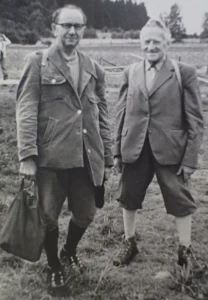
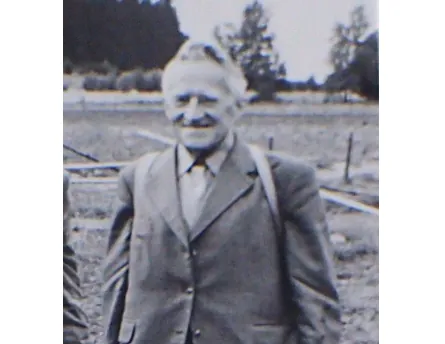
Fritz Koppe was one of the leading Central European bryologists of the twentieth century, particularly known for his contributions to bryophyte floristics, phytogeography, and ecology.
Born on 30 November 1896 in Zempelkowo, West Prussia, Koppe initially trained as a teacher before studying botany at the universities of Jena and Kiel. He obtained his doctorate from Kiel in 1922 with a study of the mud vegetation of lakes in Schleswig-Holstein and Lake Constance. In 1930, he settled in Bielefeld, where he pursued a career in education while continuing his botanical research.
Koppe devoted much of his scientific life to the study of mosses and liverworts. He published more than 150 papers, mainly on the floristics, distribution, ecology, and phytogeography of bryophytes. His investigations covered large areas of Germany and Central Europe, but also extended to Mediterranean and Atlantic regions, including Mallorca and southern Spain.
Among his major contributions was Die Moose des Niedersächsischen Tieflandes (1964), a comprehensive account of the bryophytes of the North German lowlands. His detailed knowledge of species and their distribution made him an important authority on Central European bryophytes. He was frequently consulted by colleagues, identified numerous collections sent to him, and contributed significantly to the development of bryological knowledge in the region.
Koppe was also involved in large-scale floristic mapping. From the late 1960s, he participated in the mapping of the Central European flora and, together with Ruprecht Düll, helped initiate bryophyte mapping in North Rhine-Westphalia. His broad natural-history interests, which also included vascular plants, fungi, and birds, contributed to his involvement in nature conservation and the identification of areas of botanical importance.
Over his lifetime, Koppe assembled an extensive herbarium of mosses and liverworts, including his own collections from several European countries as well as numerous specimens received from bryologists with whom he corresponded. Before his death in 1981, he entrusted the herbarium to Ruprecht Düll. The collection was later acquired by the State Museum of Natural History Stuttgart, and the proceeds from its sale were used to establish the Fritz Koppe Foundation and the Fritz Koppe Prize, created to promote and recognize outstanding work in bryology.
Koppe received several distinctions for his scientific contributions, including the Cultural Prize of the Senate of Bremen in 1964 and the Cultural Prize of the City of Bielefeld in 1971. His work remains an important contribution to the floristic and phytogeographical knowledge of European bryophytes.
References
Lienenbecker, H. (1981). Fritz Koppe †. Natur und Heimat, 41: 94–95