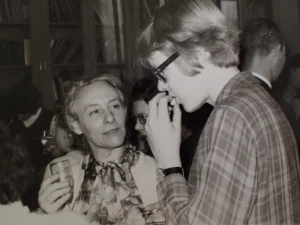
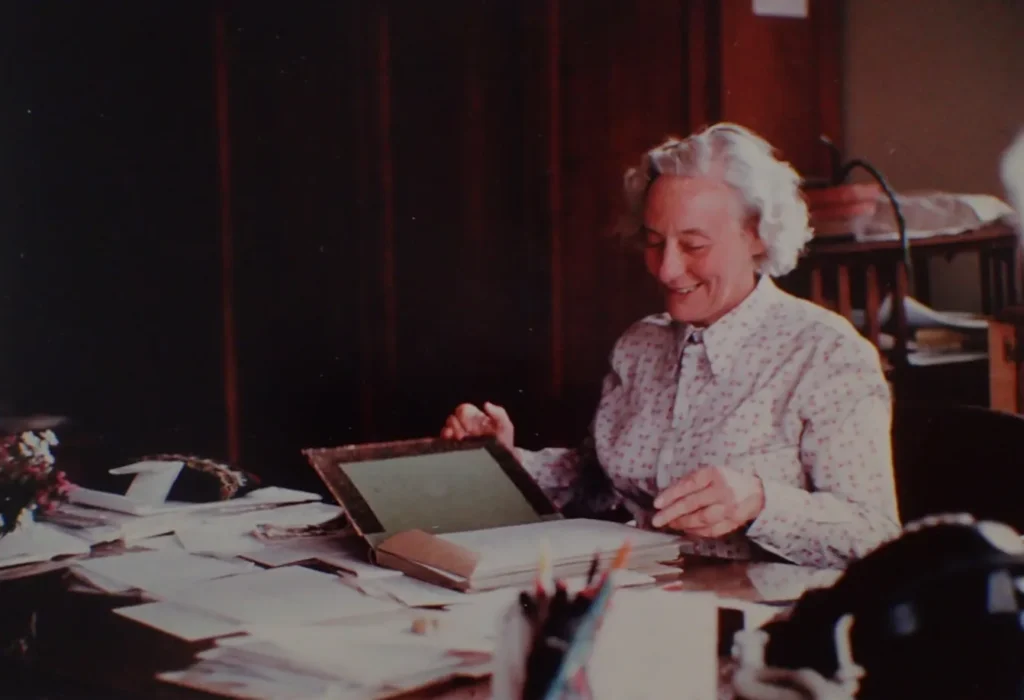
Suzanne Jovet-Ast (1914–2006) was a French botanist and bryologist whose research made important contributions to the taxonomy, ecology and biogeography of liverworts, particularly those of the Mediterranean region and arid environments.
Born in Paris on 8 February 1914, she studied natural sciences at the Sorbonne, graduating in 1934 with training in botany, physiology and geology. She subsequently joined the Muséum national d’Histoire naturelle in Paris, initially as an independent researcher and later as a doctoral fellow. Her early research concerned the anatomy and geographical distribution of Annonaceae from Indochina, the subject of the doctoral thesis she defended in 1943.
Her interest in bryophytes, and especially liverworts, developed while she was working with Pierre Allorge in the cryptogamy laboratory of the Muséum. From the 1940s onward, bryology became the central focus of her scientific career. Her early work included experimental studies on liverwort cultures, but she increasingly concentrated on taxonomy, ecology and geographical distribution.
From the early 1950s, Jovet-Ast devoted particular attention to the bryophytes of the Mediterranean Basin. Together with Hélène Bischler and other collaborators, she contributed to a broad research programme on Mediterranean and arid-zone bryophytes. This work combined taxonomic studies with ecological and biogeographical approaches, seeking to understand not only the identity and distribution of species, but also the environmental factors controlling their occurrence and the history of bryophyte colonization around the Mediterranean. Particular attention was given to liverwort genera such as Riccia, Plagiochasma and Fossombronia.
Among these groups, Riccia became especially closely associated with her scientific work. Jovet-Ast devoted many years to the study of this taxonomically difficult and morphologically diverse genus, examining species delimitation, morphology and geographical distribution. Her studies contributed substantially to improving knowledge of Riccia in Mediterranean and arid regions and helped establish a stronger systematic framework for the genus.
Her approach to bryology was characteristically broad. Taxonomic investigations were integrated with studies of autecology and community ecology, the relationships between bryophyte assemblages and vascular-plant vegetation, and patterns of geographical distribution. This combination of systematics, ecology and biogeography was an important feature of her research and reflected her wider botanical training.
Jovet-Ast held senior scientific positions at the Muséum national d’Histoire naturelle and in 1975 became head of its Cryptogamy Laboratory. However, research remained a central part of her life throughout her career. Even after her retirement in 1982, she continued her bryological studies. After moving to Biarritz, she established a working laboratory in her home and continued her research on Riccia for many years.
Suzanne Jovet-Ast died on 22 February 2006, shortly after her ninety-second birthday. Her collections were bequeathed to the Muséum national d’Histoire naturelle in Paris.
References
LAMY D. 2007. — Suzanne Jovet-Ast (8 février 1914, Paris – 22 février 2006, Biarritz). Cryptogamie, Bryologie 2007 (2): 159-183.