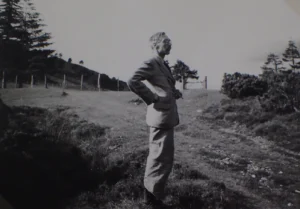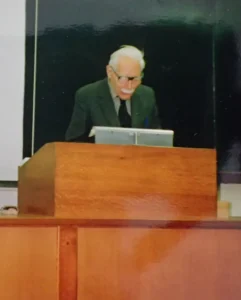
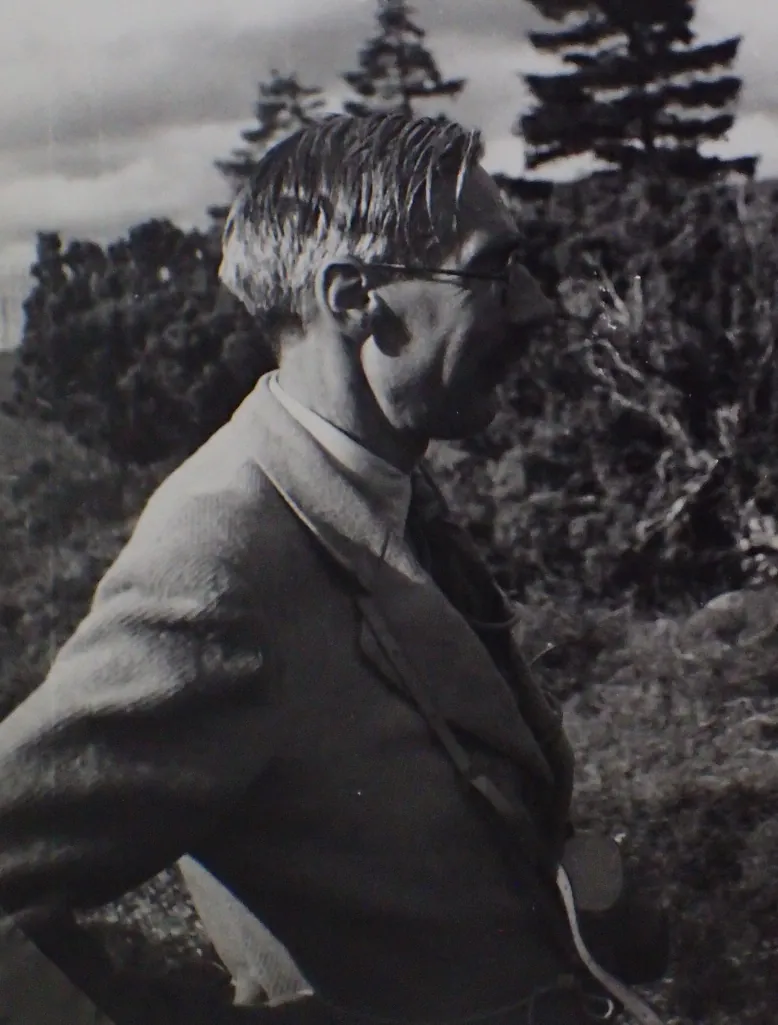
Eustace Wilkinson Jones (1909–1992) was a British bryologist, forester and plant ecologist, and one of the leading specialists of his generation on African liverworts. Although most of his bryological research was carried out in his spare time alongside a professional career in forestry, his meticulous observations, extensive fieldwork and taxonomic studies made a lasting contribution to the knowledge of African bryophytes.
Born in Walsall, Staffordshire, Jones developed an early interest in field botany. As a schoolboy he carried out an ecological survey of the vegetation of Sutton Park. His fascination with bryophytes was first stimulated by his grandfather, a keen naturalist, who showed him the striking green reflection produced by the protonemata of Schistostega pennata. Jones entered Jesus College, Cambridge, in 1928, where he obtained first-class honours in Natural Sciences and later completed a PhD on the physiological relationships between cells and their surrounding medium in the freshwater alga Cladophora.
In 1934, Jones joined the Oxford Forestry School, where he remained until his retirement in 1972. His professional work focused on forest ecology, structure and regeneration, both in Britain and in tropical Africa. This ecological background strongly influenced his approach to bryology: throughout his career he was especially interested in understanding “what grows where and why”.
Jones rapidly developed an excellent knowledge of British mosses and liverworts, collecting them extensively during forestry fieldwork throughout Britain. He participated in the first Cambridge Expedition to the Cairngorms in 1938, combining ecological studies with intensive bryophyte collecting. He later published several important contributions to British bryology, including his Bryophyte Flora of Berkshire and Oxfordshire (1952–1955) and, nearly forty years later, The changing bryophyte flora of Oxfordshire (1991), in which he examined changes in the local bryophyte flora and their possible causes.
His major contribution, however, concerned the bryophytes of tropical Africa. This work began in 1947–1948, when he joined the second Cambridge University Expedition to Nigeria. During five months of fieldwork, he collected in the lowland forests of southern Nigeria, the Idanre Hills, and what was then British Cameroons, including the bryophyte-rich montane forests of Mount Cameroon. Further visits to West and East Africa during his forestry career allowed him to build an extensive personal collection and an exceptional first-hand knowledge of African bryophytes.
Between 1952 and 1992, Jones published a remarkable series of 42 papers under the title African hepatics. Initially based largely on his own collections and those made during earlier Cambridge expeditions, the series gradually expanded to incorporate material from many parts of tropical and southern Africa. His studies ranged from accounts of individual species to detailed treatments of taxonomically difficult groups, including Plagiochila and the Lejeunea flava complex. His work was widely admired for the accuracy of its observations, careful descriptions and close attention to variation.
Jones also explored bryophyte floras from regions that were still poorly known. His 1985 account of the bryophytes of the savannas and forest outliers of northern Nigeria, for example, provided important information from an area that had previously been little studied bryologically. He also collaborated on an account of the hepatics of Sierra Leone and Ghana.
After retiring from Oxford, Jones was finally able to devote himself fully to bryology. One of his principal ambitions was to synthesize his decades of work in a complete liverwort flora of West Africa. The manuscript remained unfinished at the time of his death in 1992, but was later edited by M. J. Wigginton and published posthumously in 2004 as E. W. Jones’s Liverwort and Hornwort Flora of West Africa, an important reference for the bryophyte flora of the region.
Jones was also closely associated with the British Bryological Society, which he joined in 1933 and later served as President and as editor of its Transactions.
His contribution to bryology is reflected in several taxa named in his honour, including the moss genus Jonesiobryum and the species Trichostelium jonesii, Lopholejeunea jonesii and Radula jonesii.
Through more than four decades of fieldwork and publication, Eustace W. Jones combined ecological insight with exceptionally careful taxonomy. His work greatly improved the knowledge of tropical African liverworts and remains an important foundation for bryological research in the region.
From
Obituaries. (1993). Journal of Bryology, 17(4), 689–700. https://doi.org/10.1179/jbr.1993.17.4.689