

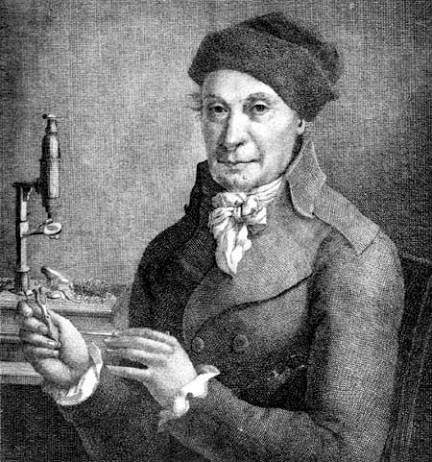
Johannes Hedwig was a physician, botanist and one of the founders of modern bryology. He was born on 8 October 1730 in Kronstadt, Transylvania (now Brașov, Romania). His father was a shoemaker who also held a position in the municipal council. Hedwig attended the Honterus Gymnasium in Kronstadt and, after his father’s death, continued his education in Pressburg, now Bratislava. In 1752 he moved to Leipzig, where he studied medicine under difficult financial circumstances and received his medical doctorate on 18 May 1759.
Unable to establish himself as a physician in his native Transylvania, Hedwig remained in Saxony and practised medicine, particularly in Chemnitz. Alongside his medical work, he developed an increasing interest in botany and bryophytes. His access to progressively better microscopes was decisive. It enabled him to examine mosses with an accuracy that was exceptional for his time and to investigate structures that earlier botanists had been unable to interpret clearly.
Hedwig’s studies of the reproductive organs and development of mosses were particularly influential. He carefully described and illustrated structures such as antheridia, archegonia, protonemata, capsules and peristomes, and demonstrated the value of these characters for classification. Although the bryophyte life cycle was not yet understood in its modern sense, his microscopic observations fundamentally changed the way mosses were studied and helped establish bryology as a distinct scientific discipline.
His scientific reputation eventually brought him back to Leipzig. In 1789 he became Professor of Botany at the University of Leipzig and Director of its Botanical Garden. His major works combined microscopic observation, detailed illustration and systematic comparison of bryophyte characters. His most influential book, Species Muscorum Frondosorum, was published posthumously in 1801 by Friedrich Schwägrichen. It became the nomenclatural starting point for moss names, with the exception of Sphagnum, and remains one of the foundational works of moss taxonomy.
Hedwig died in Leipzig on 18 February 1799. His herbarium and much of the original material associated with his taxonomic work are preserved today in the Conservatoire et Jardin botaniques de Genève, giving his collections continuing importance for bryophyte nomenclature and typification.
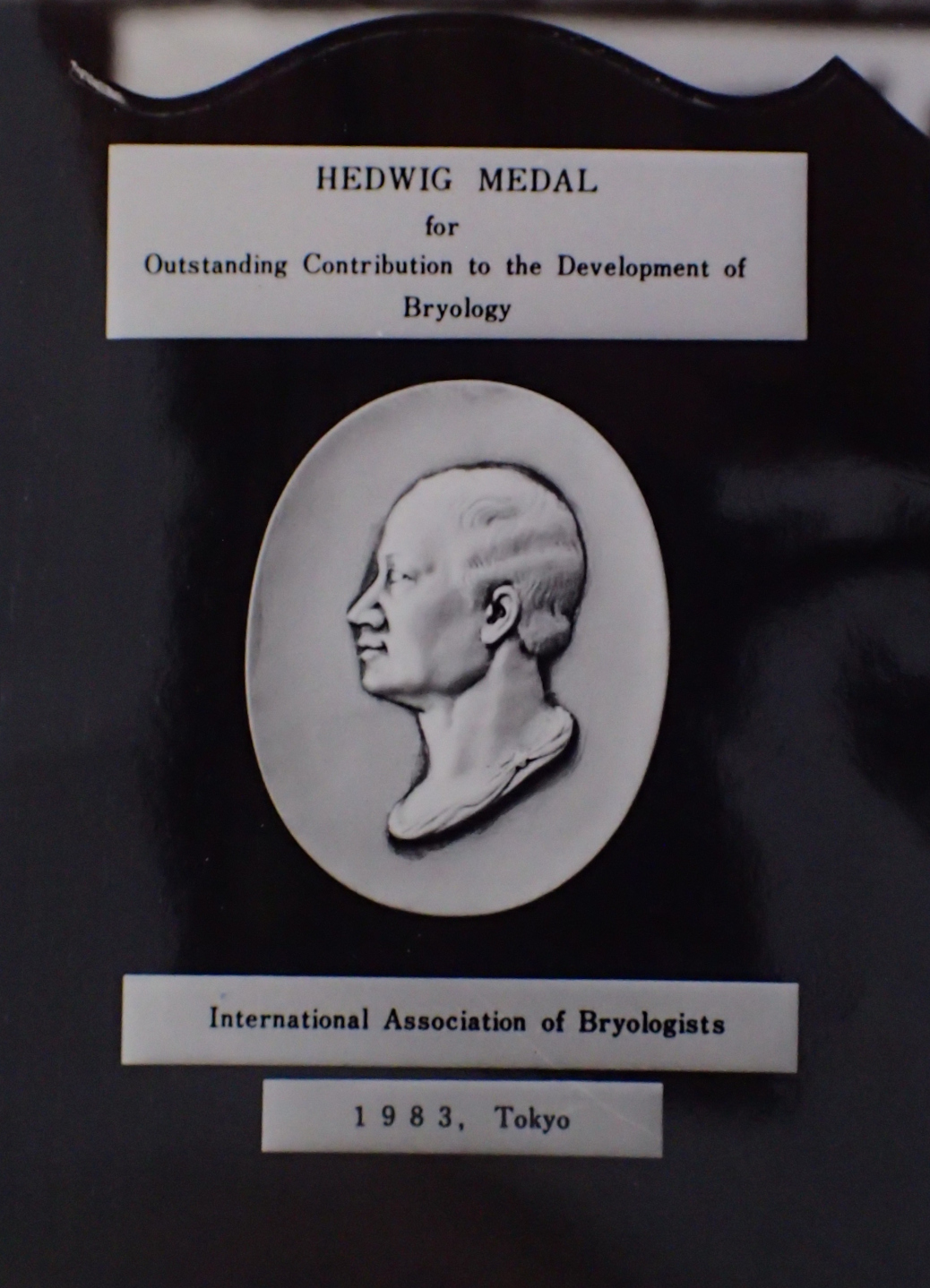
His name remains closely associated with the highest distinction awarded by the International Association of Bryologists. The Hedwig Medal, initiated at the IAB taxonomic workshop in Geneva in 1979, recognizes outstanding lifetime contributions to bryology and was the first medal established by the Association
References:
Frahm, J.-P. (2000). The life and work of Johannes Hedwig. Nova Hedwigia, 70, 1–13.
Price, M. J. (2005). L’herbier de Johannes Hedwig aux Conservatoire et Jardin botaniques de la Ville de Genève et son catalogue de types. La Feuille Verte, 36, 12–14.
Price, M. J. (2005). Catalogue of the Hedwig-Schwägrichen herbarium (G): I. List of type material and a review of typifications for the Hedwig moss names. Boissiera, 61, 1–388.
Price, M. J. (2024). The founding of modern bryology and the legacy of Johannes Hedwig: Eight good practices for bryophyte taxonomy. Bulletin de la Société Neuchâteloise des Sciences Naturelles, 144, 221–237. https://doi.org/10.5169/seals-1072433