
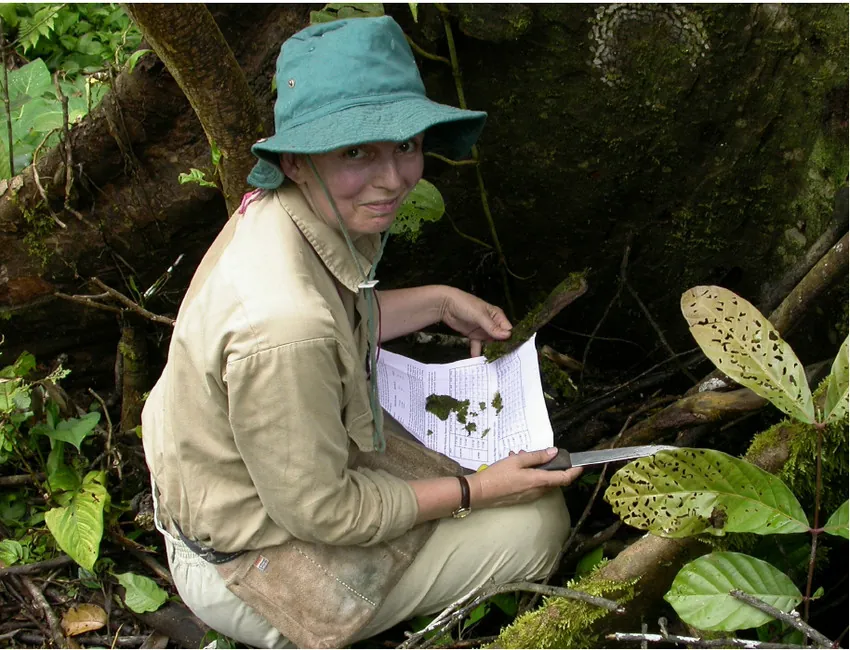
Elizabeth Anne Brown was an Australian–New Zealand botanist and bryologist, best known for her work on liverwort systematics, her deep commitment to herbarium collections, and her generous role in developing bryological research in Australasia and the Pacific. She was born in Auckland, New Zealand, on 15 November 1956, shortly after her parents had emigrated from northern England. Her father, John Martin Ainley Brown, was Professor of Plant Physiology at the University of Auckland, and scientific rigour became an important influence in her life. She studied at the University of Auckland, where she completed a Bachelor of Science degree, followed by a Master of Science with honours in 1981 on New Zealand Targioniinae and Marchantiinae. She then completed a PhD in 1987 on the New Zealand Aneuraceae, already establishing the group of liverworts that would remain central to much of her scientific career.
Brown’s early bryological work focused especially on liverwort systematics. Her PhD included a revision of the genus Riccardia in New Zealand, published with John Braggins in the Journal of the Hattori Botanical Laboratory in 1989. This work led to the description or new combination of numerous taxa in the Aneuraceae, including several species of Riccardia. Her name is also associated with taxa in other liverwort families, including Zoopsis bicruris, Mnioloma stamatotonum, Acromastigum furcatifolium, and Radula ornata.
In 1989, Brown moved to Australia as the second recipient of the Research Fellowship at the National Herbarium of New South Wales in Sydney. The herbarium had invited specialists in fields where its expertise was limited, and Brown’s knowledge of liverworts made her a particularly valuable appointment. After the fellowship ended, she remained at NSW, first using her own funds and later through temporary and part-time positions, before being appointed Scientific Officer in 1993. There she continued her research on liverworts, curated the cryptogam collections, and became a central figure in the development and organisation of bryophyte collections at the herbarium.
Although Brown also worked on vascular plants, including Asteraceae and Ericaceae, bryophytes remained at the heart of her scientific identity. She was deeply committed to fieldwork and collected extensively in Australia, especially Tasmania, Queensland and Lord Howe Island, as well as in New Zealand, New Caledonia, Fiji, Papua New Guinea, Vanuatu and Malaysia. Lord Howe Island became one of her most frequently visited field sites. There she collected bryophytes and weeds while also helping with conservation work, including the removal of invasive asparagus fern. In the field she was tireless: long days of collecting were followed by careful processing of both vascular plants and bryophytes, often late into the evening.
Her field abilities are vividly recalled by Tamás Pócs, who worked with her on several expeditions in Australia and Fiji between 2000 and 2011. Their collaboration began in 2000, when Pócs examined Brown’s collections at NSW and found a minute papillose Radula from the Bellenden Ker area of Queensland. This species was soon described as Radula ornata E.A.Br. & Pócs. Brown’s skill as a collector was particularly evident in her ability to detect very small and easily overlooked liverworts. During fieldwork in New South Wales, she collected sufficient material of the rare Microlejeunea ocellata, and in Queensland she helped document several important records, including Nowellia curvifolia, new to Australia.
In 2001, Brown joined further bryological collecting in Queensland, including sites such as the Atherton Tableland, Mt Lewis, Palmerston National Park, Russell River National Park and Bellenden Ker. At Bellenden Ker, she guided colleagues to the type locality of Radula ornata, growing on the bark of Agathis atropurpurea at high elevation. The expedition produced important collections of corticolous liverworts, including several species of Lejeuneaceae and Frullaniaceae, and records new to Australia such as Drepanolejeunea pleiodactyla and Frullania hodgsoniae. Brown also collected epiphyllous liverworts in lowland rainforest and participated in work that led to new Australian records of Nowellia langii and Jubula hutchinsiae.
Brown also played a significant role in the exploration of Pacific cryptogams. In 2008 she joined the Fiji expedition organised by Matt von Konrat and hosted by the South Pacific Regional Herbarium in Suva. The aim was to study cryptogamic diversity and help train Fijian specialists. Brown’s particular responsibility was to work on members of the Aneuraceae and Lepidoziaceae. The expedition contributed to a broader reassessment of Fijian bryophytes and resulted in several publications, including a history of cryptogam research in Fiji and a checklist of Fijian hornworts and liverworts. She returned to Fiji in 2011 to continue this work, collecting in the Savi Basin Natural Reserve on Viti Levu and on Kadavu Island.
Beyond her own publications, Brown had a strong influence as a mentor and collaborator. She co-supervised many students at the University of Sydney, the University of New England and James Cook University, including projects on liverwort groups such as Telaranea, Lejeunea, Lepidoziaceae and Hypnaceae. Matt Renner, who worked with her as a student and later as a postdoctoral fellow at NSW, became one of her close scientific collaborators. Brown was also an important guide for volunteers and technical staff working on cryptogams, and with Kathi Downs she helped transform the physical curation and organisation of the bryophyte collections at NSW.
Her publication record shows a gradual shift from classical revisionary taxonomy towards molecular systematics, phylogenetics and integrative taxonomy. She contributed to studies on Lepidoziaceae, Lejeuneaceae, Radulaceae and other liverwort groups, including work on cryptic species, morphological variation, heterochrony and molecular phylogenetic relationships. Several of her later papers, especially with Matt Renner and other collaborators, dealt with difficult species complexes in Radula and Lejeunea, combining morphology, molecular data and biogeographic interpretation.
From 2006 until her illness, Brown was also Scientific Editor of Telopea, where she helped authors and guided the journal through the transition from email-based submission to full electronic publishing. Her editorial work reflected the same qualities that marked her scientific life: patience, precision, modesty and a strong sense of service to the botanical community.
Colleagues remembered Elizabeth Brown as modest, diligent, generous and exceptionally competent in the recognition of liverwort genera and species. Tamás Pócs emphasized her sharp eye for minute bryophytes, her field enthusiasm, her kindness to colleagues and local people, and her cheerful endurance under difficult conditions. Her death on 17 November 2013, only two days after her fifty-seventh birthday, was a major loss for Australasian bryology. Through her collections, taxonomic work, students, collaborations and herbarium curation, she left a lasting legacy in the study of liverworts, especially in Australia, New Zealand and the Pacific.
References
Pocs, T (2014) Elizabeth A. Brown, a splendid tour guide, friendly companion and excellent collector. Teleopea 17: 93–97 https://doi.org/10.7751/telopea20147562
Murray L.J. & Conn B.J. (2014) Elizabeth Anne Brown 15 November 1956 – 17 November 2013 Teleopea 17: 1–10 https://doi.org/10.7751/telopea20147465