
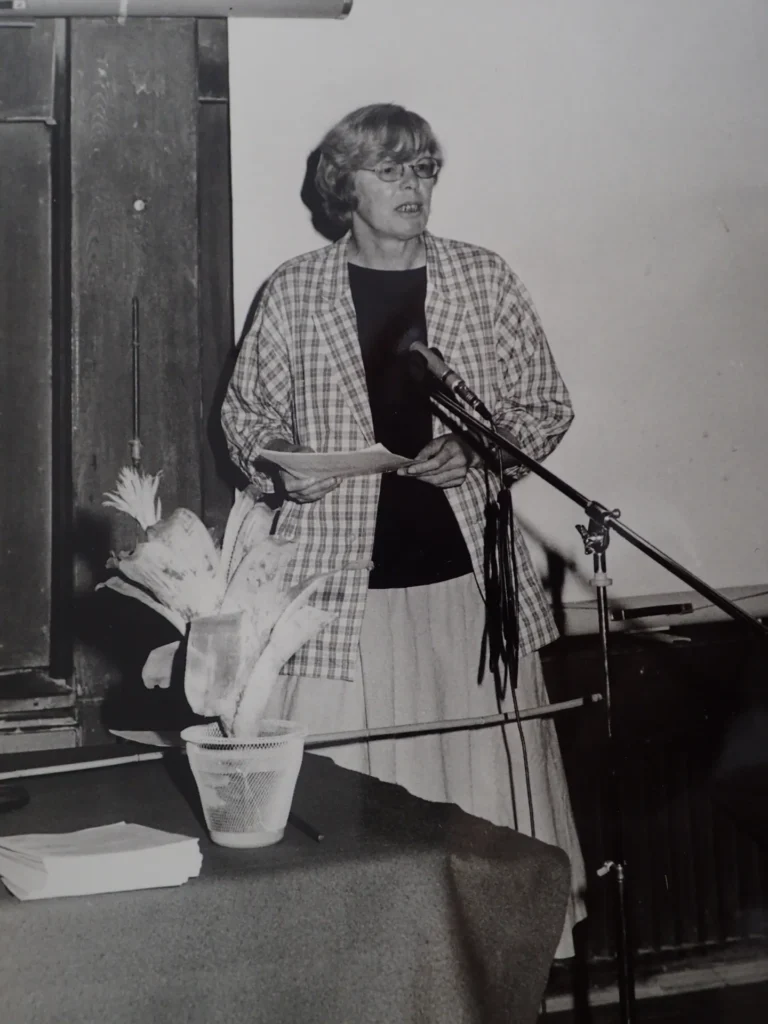
Hélène Bischler (born 3 January 1932 in Bern, Switzerland; died 12 February 2005 in Paris, France) was a French botanist and bryologist who specialised in the systematics of liverworts (Hepaticae).
Hélène Bischler-Causse, born Hélène Heiniger in Bern, Switzerland, on 3 January 1932, was one of the leading hepaticologists of the second half of the twentieth century. She devoted her scientific career to the taxonomy, systematics, ecology and evolution of liverworts, with particular emphasis on Calypogeia, Lejeuneaceae and, above all, the complex thalloid liverworts of the Marchantiidae. She died in Paris on 12 February 2005.
Bischler-Causse studied at the University of Geneva, where she obtained her PhD in natural sciences in 1957. Her doctoral dissertation dealt with a revision of the genus Calypogeia in Switzerland, already marking the beginning of a lifelong commitment to hepaticology. Before settling in France, she held research positions at the Universidad Nacional in Bogotá, Colombia, from 1956 to 1959, and at the Conservatoire Botanique in Geneva from 1960 to 1961. In 1961 she joined the Centre National de la Recherche Scientifique in Paris, working at the Laboratoire de Cryptogamie of the Muséum national d’Histoire naturelle. She remained associated with the CNRS and the Paris cryptogamy laboratory for the rest of her career, until her retirement in 1997. During this long period, she worked successively within research groups devoted to Neotropical liverworts, Mediterranean liverworts, cryptogam evolution, biodiversity and molecular systematics.
Her scientific interests evolved over time but remained firmly centred on liverworts. Her early work concerned the systematics of Neotropical hepatics, an interest strengthened by her years in Colombia and by extensive fieldwork in tropical America. She later developed a major programme on the ecology and biogeography of Mediterranean liverworts, often in collaboration with Suzanne Jovet-Ast. This work contributed to a better understanding of liverworts in arid and semi-arid environments, where Mediterranean Marchantiales show striking adaptations to drought, disturbance and seasonal habitats. Later in her career, Bischler-Causse concentrated increasingly on the systematics and evolution of the Marchantiidae, integrating morphology, ecology, life-history traits and, with collaborators, molecular approaches.
Bischler-Causse’s contribution to the taxonomy of Marchantiales was especially important. She produced a worldwide revision of the genus Marchantia, treating the New World species in 1984, the Asiatic and Oceanic species in 1989, and the European and African species in 1993. These monographs, published in Bryophytorum Bibliotheca, provided detailed morphological descriptions, illustrations, synonymy and distributional information, and became essential references for the genus. Her 1993 treatment of the European and African taxa explicitly completed the worldwide revision of Marchantia begun in the earlier volumes.
Beyond Marchantia, she also produced major synthetic works on Marchantiales as a whole. Her book Systematics and Evolution of the Genera of the Marchantiales, published in 1998, summarized her broader view of relationships within the group. In this work and in later syntheses, she paid particular attention not only to morphological characters but also to ecology, reproductive biology and life-history strategies. The Flora Neotropica monograph on Marchantiidae, published in 2005 with S. Robbert Gradstein, Suzanne Jovet-Ast, David G. Long and Noris Salazar Allen, treated 103 Neotropical species of Marchantiales and Monocleales and included extensive sections on morphology, ecology, distribution, life-history traits and phylogeny.
One of the distinctive aspects of Bischler-Causse’s work was her ability to connect classical taxonomy with ecological and evolutionary interpretation. In the Flora Neotropica treatment, Marchantiales and Monocleales are described as terrestrial or saxicolous plants often growing in harsh or disturbed habitats, with drought tolerance, microtopography and microclimate playing major roles in their distribution. The same work develops life-history groupings previously proposed by Bischler, linking ecological strategies, reproductive effort, spore size, drought tolerance and familial or generic relationships. This approach gave her taxonomic work a broader evolutionary framework.
Her influence was also institutional and editorial. She was editor of Cryptogamie, Bryologie-Lichénologie for more than thirty years, helping to sustain one of the major European journals devoted to cryptogamic botany. She co-authored several volumes of Index Hepaticarum, contributed to numerous floras, and introduced many students and visiting researchers from around the world to the study of liverworts. Through this mentoring role, she helped shape an international generation of hepaticologists.
Bischler-Causse was active in the international bryological community and served as vice-president of the International Association of Bryologists from 1981 to 1987. Her scientific achievements were widely recognized. She received the Plantamour-Prévost Prize of the University of Geneva in 1953, the P. Bertrand Prize of the Académie des Sciences in Paris in 1974, the Geneva Sayre Award of Harvard University in 1985, and the Hattori Prize of the International Association of Bryologists in 1995, awarded for her monograph of the genus Marchantia.
By the end of her career, Hélène Bischler-Causse had published more than 120 scientific papers and several major books. Her work combined field experience in Colombia and the Mediterranean region, meticulous herbarium-based taxonomy, floristic synthesis, and a growing concern with evolutionary interpretation. She remains particularly associated with the modern systematic treatment of Marchantia, Plagiochasma and the Marchantiidae. Her career represents one of the major twentieth-century contributions to hepaticology, and her influence continues through her monographs, students, collaborators and the collections and literature she helped to build.
References
Lamy, D. 2006. Helene Bischler-Causse (Bern, Switzerland, 3 January 1932 – Paris, France, 12 February 2005). Cryptogamie, Bryologie 27(1): 5–34.
Bryological Times, International Association of Bryologists. 2005. Obituary: Helène Bischler-Causse. Bryological Times 115: 2.
Biography adapted from the French-language Wikipedia article “Hélène Bischler” (CC BY-SA 4.0).
Images: © From S. R. Gradstein’s personal collection.