Lewis Edward Anderson was born on 16 June 1912 near Batesville, Mississippi, USA, into a farming family. He showed remarkable academic ability from an early age, leaving high school at 15 and graduating from Mississippi State University with a Bachelor of Science at the age of 19. He then undertook postgraduate studies in botany at Duke University, Durham, North Carolina, USA, where he received a master’s degree in 1933. It was at Duke, under the influence of Hugo Leander Blomquist, that he developed his interest in mosses. He later completed his PhD at the University of Pennsylvania at the age of 22.
In 1936, Anderson joined the faculty of the Department of Botany at Duke University initially specializing in cytology. He was also given responsibility for curating the moss herbarium, a role that gradually redirected his research from cellular cytology toward the ecology, taxonomy and classification of mosses. Together with his colleague Ruth Margery Addoms, he helped develop Duke’s first general botany course.
During the Second World War, Anderson took leave from Duke to serve in the United States Navy. In 1945, he served as an intelligence officer aboard the aircraft carrier USS Hancock in the Pacific. He was awarded a Bronze Star and left the Navy as a lieutenant commander before returning to Duke, where he continued his teaching, research and curatorial work.
Anderson made major contributions to the study of North American mosses. He frequently collaborated with Howard A. Crum, and in 1981 they published the two-volume Mosses of Eastern North America, a landmark work for the bryoflora of the region. Together, they also edited the exsiccata Mosses of North America. At Duke, Anderson played a central role in expanding the bryophyte herbarium and in developing graduate training in bryology.
He was also active in the bryological community. He served as President of the International Association of Bryologists from 1975 to 1981, contributing to the development and visibility of the association during an important period in its history.
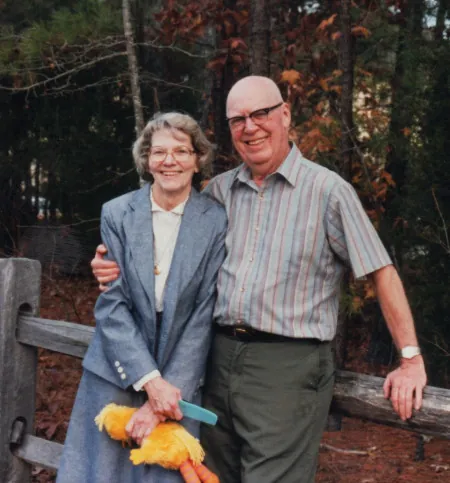
Throughout his career, Anderson was supported by his wife, Pat, whom he met while she was a nursing student at Duke and married in 1941. She accompanied him on field trips, helped record collecting localities, managed specimen packets, and assisted in the preparation and distribution of The Bryologist.
Lewis E. Anderson retired from Duke University in 1982. His legacy remains closely associated with the study of North American mosses and with the growth of bryology at Duke. The moss genus Bryoandersonia was named in his honour by Harold E. Robinson, and several species also bear his name. In 1998, the bryophyte herbarium at Duke University was officially named the L.E. Anderson Bryophyte Herbarium; it now holds approximately 260,000 specimens. Anderson died on 1 February 2007.
Image: © From S. R. Gradstein’s personal collection.